Shopify vs Custom Website for Ecommerce: An Honest Guide
Your ecommerce platform is either saving you money or quietly draining it — and most founders cannot tell which. A revenue-stage decision framework with real numbers to help you choose between Shopify and a custom build.

Most ecommerce founders asking “should I stay on Shopify or build a custom website?” are afraid of the same two things. Paying monthly fees for a platform they will outgrow. Or spending six figures on a custom build they do not need yet.
The answer depends on your revenue stage, not your ambition. Below $1M in annual sales, Shopify wins for almost every ecommerce business. Above $5M, the maths change entirely — and most comparison articles never explain where that tipping point actually sits.
Shopify vs Custom Ecommerce Website — The Short Answer
Shopify is a rented storefront. You pay monthly, they handle hosting, security, updates, and payment processing. You pick a theme, add your products, and you have a working store in days.
A custom ecommerce website is property you own. You choose the framework, the hosting, the payment gateway, and every detail of the checkout flow. You hire developers to build it and maintain it — or you partner with a studio that handles both.
Neither is universally better. The right choice comes down to three things: your current annual revenue, how fast you are growing, and whether your product experience needs to do something a Shopify theme cannot.
If you sell standard products with standard shipping and you are doing under $1M per year, Shopify is almost certainly the right platform. If you are above $5M and your total Shopify costs — subscription fees, app charges, developer workarounds — are eating into margin, a custom build stops being a preference and starts being a financial decision.
What Shopify Costs You — Beyond the Monthly Fee
Shopify’s pricing page shows clean monthly tiers. The real cost is less visible.
Shopify Basic starts at $39 per month. That gets you a working store with themes, checkout, and basic analytics. But most growing stores quickly stack paid apps for product reviews, email marketing, upsell funnels, loyalty programmes, advanced filtering, and subscription management. A realistic app stack costs $200–$500 per month — and that number only climbs as you add functionality.
Transaction fees add another layer. Unless you use Shopify Payments exclusively, Shopify charges 0.5–2% on every transaction on top of your payment processor’s fees. At $500K in annual revenue, that is $2,500–$10,000 per year in platform transaction fees alone. If you accept payments through third-party gateways like PayPal or Klarna — which many customers expect — those fees stack on top of Shopify’s platform cut.
Then there are the costs nobody plans for. Premium themes run $150–$400. Custom Liquid development — the kind you need when a theme cannot do what you want — costs $100–$200 per hour for a qualified Shopify developer. Small customisation requests add up fast when every change requires code.
Shopify Plus starts at approximately $2,300 per month. It unlocks checkout customisation, expanded API access, Shopify Flow automation, and dedicated account support. For brands between $1M and $5M in annual revenue, Plus often justifies its price — but it is still a rental.
The total cost of ownership over three years for a serious Shopify store — subscriptions, apps, transaction fees, theme customisation, and developer hours combined — typically lands between $30,000 and $120,000. That is the real benchmark a custom build must beat to make financial sense.
What a Custom Ecommerce Build Actually Requires
A properly built custom ecommerce site is not cheap. Anyone quoting $5,000 is selling you a WordPress template with WooCommerce bolted on — not a custom build.
A genuine custom ecommerce website — built on a modern framework with secure payment integration, inventory management, and production-ready infrastructure — starts at $50,000. Complex builds with custom product configurators, multi-currency support, B2B pricing, or subscription billing logic can reach $100,000–$150,000. Timelines run 3–8 months depending on scope.
Ongoing costs include hosting ($50–$500 per month depending on traffic), security monitoring, and developer maintenance at $1,000–$3,000 per month. You need someone — in-house or agency — who can ship updates, patch security vulnerabilities, and scale infrastructure during traffic spikes like a product launch or a seasonal sale.
The critical difference is that these costs stay relatively flat as revenue grows. Your hosting bill does not scale linearly with sales. There is no platform transaction fee on every order. You pay your payment processor — Stripe, for example, charges 1.4–2.9% depending on region — and nothing on top.
At $5M in annual revenue, the gap between Shopify’s fee structure and a custom site’s flat maintenance cost can exceed $50,000–$100,000 per year. That is not theory — it is the actual margin improvement that drives the migration decision for most high-revenue brands.
The Revenue-Stage Decision Framework
This is the part most Shopify vs custom website articles skip entirely. They list the pros and cons but never tell you when each option actually makes financial sense for your specific ecommerce business. Here is the framework, based on what we have seen across dozens of builds and migrations.
Under $500K per year: Stay on Shopify Basic or Shopify. Your priority is product-market fit, not platform optimisation. Shopify’s speed to market and low upfront cost mean you can focus on selling and learning what your customers actually want. A custom build at this stage is over-engineering a problem that does not exist yet.
$500K–$1M per year: Start tracking your total Shopify spend honestly. Add up every monthly subscription, every app fee, every transaction fee. If the total platform cost stays under 5% of revenue, Shopify is still working for you. If it is creeping above that — or if you are hitting feature walls on checkout, shipping logic, or customer account functionality — get a quote on what a migration would cost. Do not migrate yet. Just know the number.
$1M–$5M per year: This is Shopify Plus territory. At this revenue range, Shopify Plus is often the best choice. You get enterprise-grade features, checkout extensibility, Shopify Flow for automation, and a platform that scales without you managing servers. The infrastructure work of handling PCI compliance, maintaining uptime during peak traffic, and managing your own hosting is significant — and Shopify Plus handles all of it. The majority of brands we have worked with in this range chose to stay on Plus after comparing the full cost and timeline of a custom migration. Sometimes the smarter move is to optimise what you have rather than rebuild from scratch.
Above $5M per year: The economics shift decisively. Platform fees and transaction costs on Shopify Plus can exceed $150,000 annually at this scale. A custom build with a $100,000 upfront investment and $36,000 per year in maintenance pays for itself within 18 months. This is the point where custom ecommerce becomes a financial decision, not a technical preference. The return on investment is clear and measurable.
Above $10M per year: At this revenue level, staying on a standard Shopify setup means overpaying in both fees and lost conversion opportunities. Custom or headless commerce is standard here — the savings compound annually, and the ability to optimise every step of the customer journey directly impacts millions in revenue.
The Headless Middle Ground Most Founders Miss
Most Shopify vs custom website comparisons present only two options. There is a third that often makes more sense than either: headless commerce.
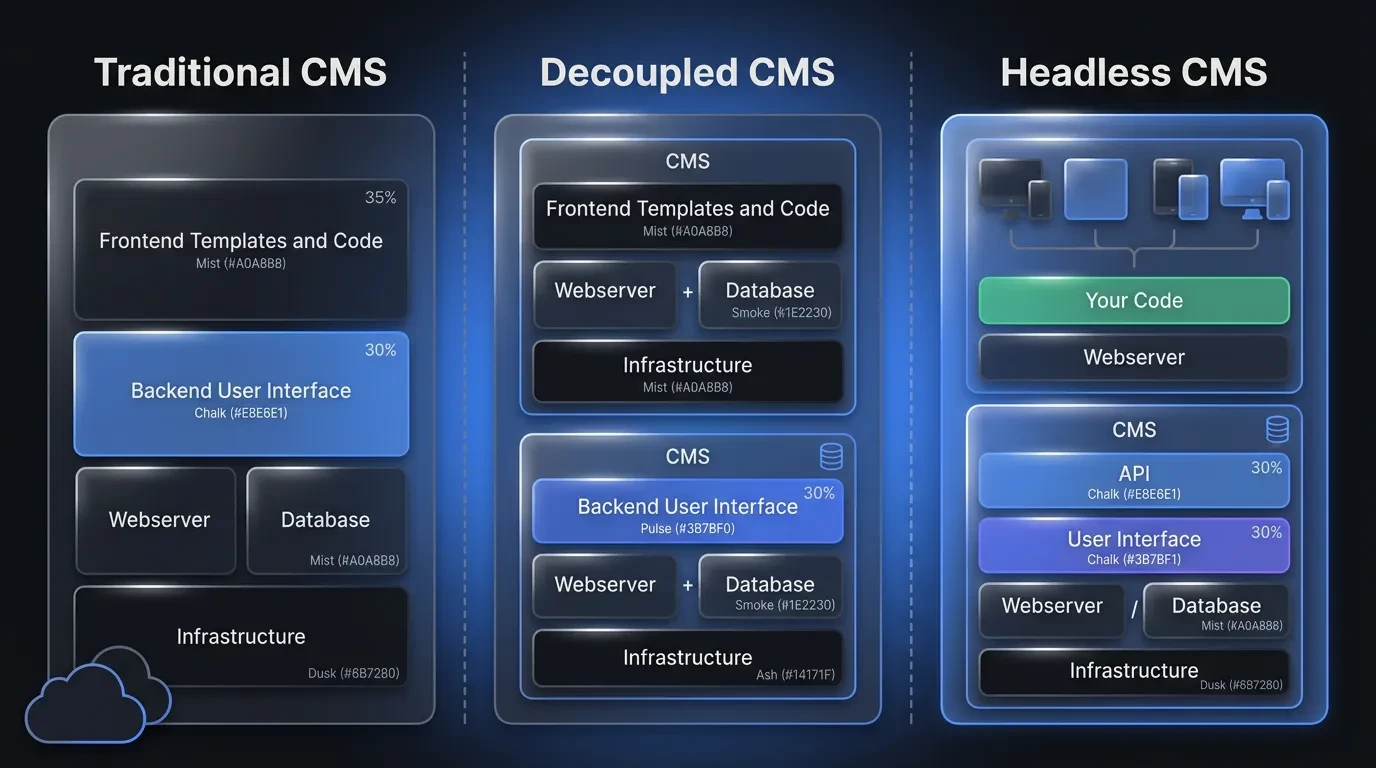
Headless means you keep Shopify’s backend — inventory, orders, payments — but build a completely custom frontend. Shopify supports this through their Storefront API and their Hydrogen framework. The result is full design freedom and frontend performance with Shopify’s reliable backend infrastructure handling operations.
The cost sits between a standard Shopify theme and a full custom build. A headless frontend typically costs $30,000–$80,000 to develop, plus your ongoing Shopify subscription. You still pay Shopify’s transaction fees, but you control every pixel of the customer experience — page speed, animations, product pages, checkout flow, and mobile UX.
This is often the right move for brands between $1M and $5M who have outgrown their Shopify theme’s limitations but do not need to rebuild order management, inventory, and fulfilment from scratch. It is also a practical stepping stone — you can migrate the backend to a fully custom solution later without rebuilding the frontend your customers already know.
The risk with headless is complexity. You maintain two systems — the Shopify backend and your custom frontend — and the integration between them needs careful management. Without a development partner who understands both Shopify’s APIs and modern frontend frameworks, the integration gaps will cost more than the design freedom saves. Choose this path only if your team or agency can manage both layers confidently.
Five Signs It Is Time to Leave Shopify
Migration from Shopify to custom is a significant project — typically 4–6 months for a mid-complexity store. It is not something you do on a feeling. These are the concrete signals that the platform has become more expensive than the alternative.
Your app costs exceed your Shopify subscription. If you are paying $500 or more per month in third-party apps to make Shopify do what your business needs, the platform is working against you. That is $6,000 per year funding someone else’s SaaS products instead of building your own infrastructure.
Transaction fees have become a visible line item. At $2M or more in annual revenue, 1–2% in platform transaction fees means $20,000–$40,000 per year. That funds a part-time developer maintaining a custom site that charges zero platform fees on every sale.
Your checkout needs logic that Shopify will not allow. Custom subscription billing, B2B pricing tiers, multi-step product configuration, or region-specific payment methods — Shopify restricts what you can change at checkout, even on Plus. If you are layering third-party apps on top of each other to handle core checkout requirements, the platform is the constraint — not the solution.
App bloat is killing your page speed. Each Shopify app loads external JavaScript, tracking scripts, and inline CSS. Stack ten apps and you can add 2–3 seconds to your load time. Google’s own performance research shows that every additional second of mobile load time can reduce conversions by up to 20%. Slow pages cost real revenue — not just rankings.
You are building workarounds instead of features. If your developer spends more time hacking Liquid templates and patching app conflicts than building new functionality for your customers, the platform has become the bottleneck. The cost of working around Shopify’s limitations eventually exceeds the cost of building exactly what you need from the ground up.
What to Do Next
If your ecommerce store is under $1M in annual revenue, stay on Shopify. Focus on selling, building your customer base, and refining your product. Revisit the platform question when your app fees start to sting and your checkout begins to feel like it is holding you back.
If you are above that and the numbers in this article match what you are experiencing in your own business, the next step is a platform audit. Not a sales pitch for a rebuild — an honest comparison of what Shopify is costing you today versus what a custom or headless build would cost over the next three years.
Vediwood builds custom ecommerce websites for brands that have outgrown their platform — and we tell founders when Shopify is still the right answer. If you want a clear-eyed assessment of where your current setup stands, book a free discovery call. No pitch. Just numbers.
Follow Us
Most founders read us once and change something that week.
Every issue covers one thing that makes your website work harder — better conversion, stronger SEO, or smarter design. No fluff, no agency speak. Just the decision you need to make this week.
Our Team

Sadiki Said
Full Stack Developer

Nezha Essyed
Content Strategist