Link Building for Small Business: What Works in 2026
Your competitors are ranking higher because other websites link to them — not because their content is better. The practical guide to earning backlinks when you don't have a big budget, a dedicated SEO team, or hours to spare.

"How do you actually get other websites to link to yours?"
That question sits behind every small business owner who has been told backlinks matter but has no idea where to start. The answer is simpler than most SEO guides make it sound. Link building for small business does not require a big budget, a dedicated SEO team, or hundreds of hours. It requires knowing which tactics produce real results for your type of business — and which ones waste your time.
Why Link Building Still Decides Who Shows Up on Google
Google uses backlinks as one of its strongest ranking signals. When another website links to yours, it tells Google your content is worth referencing. For small businesses competing against larger companies, backlinks are one of the few ranking factors you can directly influence without paying for ads.
The effect is especially visible in local search. A plumber with 20 relevant backlinks from local directories, partner sites, and industry blogs will consistently outrank a competitor with zero — even if that competitor's website has better design and more pages. You do not need thousands of links. For most local and service businesses, a few dozen quality backlinks from relevant sources is enough to move from page three to page one.
Backlinks are no longer just about Google, either. AI search engines like ChatGPT Search, Perplexity, and Gemini use external mentions and citations to decide which businesses to reference in their answers. If your site is mentioned across trusted sources, AI surfaces you in responses. If it is not, you are invisible to an entire new search channel that is growing fast.
The businesses that build backlinks consistently — even slowly — compound their advantage over time. Every quality link makes the next one easier to earn and harder for competitors to catch up.
What Makes a Backlink Worth Having
Not all backlinks improve your rankings. Some do nothing. Others actively hurt.
A valuable backlink comes from a site that is relevant to your business, carries its own authority, and links to you in context that makes sense to the reader. A local accountant earning a link from their city's chamber of commerce page sends a strong signal. The same accountant getting a link from a random tech blog in another country is noise Google ignores.
Three qualities define a backlink worth pursuing:
- Relevance: The linking site's topic or location connects to your industry or service area.
- Authority: The site has genuine traffic and trust — not a network of pages built solely to sell links.
- Context: Your link sits within real editorial content, not a footer or sidebar stuffed with hundreds of other outbound links.
The distinction between dofollow and nofollow links matters too. Dofollow links pass ranking authority directly. Nofollow links (marked with a rel="nofollow" attribute) do not pass the same direct authority, but they still contribute to brand visibility and referral traffic. A nofollow link from a major news site can still drive real business.
Google's link spam policies draw a clear line: links intended to manipulate rankings violate their guidelines. Links earned through genuine value and relationships do not.
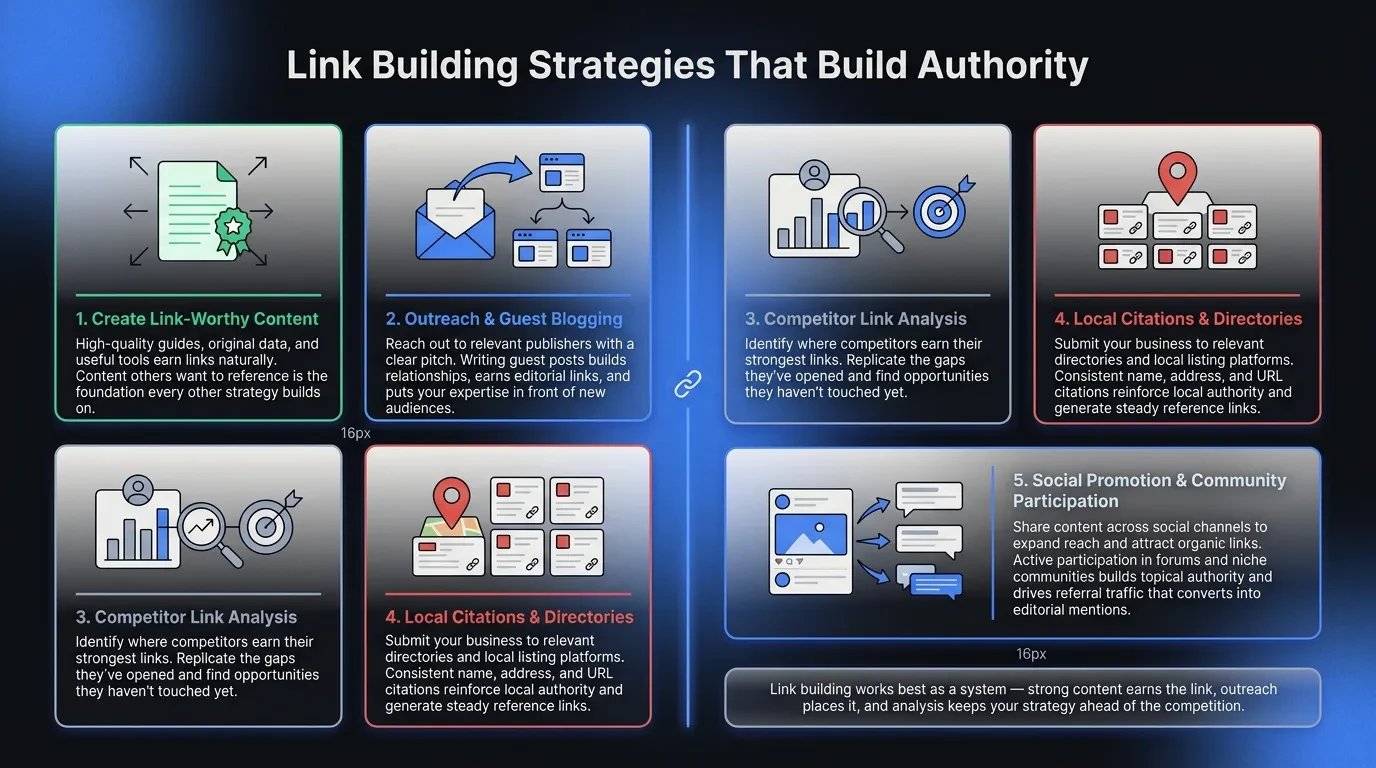
Link Building for Small Business: 7 Tactics That Actually Work
These are the tactics that produce results for service businesses, local shops, and e-commerce sites — the kinds of businesses that do not have enterprise budgets or in-house SEO teams. Each tactic is ranked by effort and return so you can decide where to start.
1. Local Citations and Directory Listings
The easiest starting point. Submit your business to Google Business Profile, Yelp, Bing Places, Apple Maps, and any directories specific to your industry. Each listing creates a citation, and many include a direct backlink to your website.
For service businesses and local shops, these citations also help Google verify that your business name, address, and phone number are consistent across the web. That consistency alone improves local search rankings before you build a single editorial link.
Start with the major platforms, then search for your industry plus "directory" to find niche-specific listings. A dentist has different directory opportunities than a landscaper. Find the ones your competitors are listed on and make sure you are there too.
Effort: low. Time: 2–3 hours for initial setup. ROI: high for local search.
2. Partner and Supplier Links
Most small businesses already have relationships that could produce backlinks without a single cold email. Suppliers, vendors, complementary businesses, and service partners often maintain websites with partner pages, client lists, or resource sections.
Reach out and suggest a mutual feature. If you use a particular tool or service and can write a short testimonial, many companies will publish it with a link back to your site. A web design agency linking to a client's site in a case study is natural and beneficial for both sides.
The key is leading with what benefits them. Do not ask for a favour — offer a testimonial, a quote for their case study, or a co-promotion idea that serves their audience.
Effort: low. Time: 1–2 hours per outreach. ROI: medium-high — contextual links from relevant domains.
3. Guest Posts on Industry Sites
Find websites in your industry that accept contributed articles. Search your niche alongside "write for us," "submit an article," or "contributor guidelines" to find opportunities. Then write something genuinely useful — not a thinly veiled ad for your business.
The link you earn sits within real editorial content, which carries substantially more ranking weight than a directory listing. Focus on publications with genuine readership and engagement rather than sites that exist solely to sell guest post placements.
One well-placed guest post on a relevant site with real traffic is worth more than ten posts on low-quality blogs nobody reads. Quality matters more than volume here.
Effort: medium. Time: 4–6 hours per post (research, pitch, write). ROI: high — editorial backlinks from relevant, authoritative sites.
4. HARO and Journalist Outreach
Platforms like Connectively (formerly Help a Reporter Out), Help a B2B Writer, and Featured connect journalists with expert sources. When a reporter needs a quote about your industry, you respond with your credentials and a direct, quotable answer. If selected, you earn a mention and typically a backlink from a high-authority media site.
Speed and specificity win here. Respond within hours of a request being posted. Include your name, title, company, and a concise expert statement — not a sales pitch. Most requests receive dozens of generic responses. The pitches that get published are specific, credible, and immediately usable by the journalist.
This tactic is unpredictable — you will not land every pitch. But when you do, a single link from a media outlet can carry more authority than a dozen directory listings.
Effort: low per pitch. Time: 15–30 minutes each. ROI: very high when successful — media backlinks carry serious weight.
5. Linkable Content Assets
Create one piece of content so useful that other websites reference it without you asking. This could be a local pricing guide, an industry statistics roundup, a downloadable checklist, or results from an original survey.
A plumber who publishes "Average Cost of Bathroom Renovation in [City] — 2026 Data" gives local bloggers and real estate agents a reason to link. A marketing consultant who publishes original data on small business website performance creates a resource other writers cite instead of doing their own research.
The best linkable assets answer a question that other content creators need to cite but do not want to research themselves. Statistics compilations work especially well — many writers link to a well-organised data roundup rather than tracking down every original source.
One strong linkable asset can attract backlinks for years with no additional outreach from you. The upfront time investment is high, but the return compounds.
Effort: high. Time: 6–10 hours for research and production. ROI: high — passive link acquisition over time.
6. Local Sponsorships and Community Involvement
Sponsor a local charity event, school programme, sports team, or community fundraiser. Most event and organisation websites list sponsors with a logo and a link. Local news coverage of the event may also mention your business.
This is link building that doubles as genuine community investment. The backlinks come from trusted local domains — exactly the type of signal Google values for local search results. And unlike guest posting or journalist outreach, these links come with real brand visibility in your community.
Even small sponsorships — donating a prize, providing a service, or volunteering expertise — can earn a mention on an event page that carries more local SEO value than many paid link schemes.
Effort: low to medium (financial or time commitment). Time: varies. ROI: medium — trusted local links plus brand awareness.
7. Business Association and Chamber Memberships
Join your local chamber of commerce, industry trade association, or professional network. Most of these organisations maintain online member directories that include a backlink to each member's website.
These links come from established, authoritative domains. A chamber of commerce site typically has strong domain authority built over decades of operation. One membership fee gets you a backlink, referral visibility, and access to networking events that can generate additional link opportunities down the line.
Effort: low. Time: 1 hour to apply. ROI: medium — authoritative domain link from a directory-style listing.
How to Prioritise When You Cannot Do Everything
Most small business owners cannot execute all seven tactics simultaneously. Here is how to sequence them based on where you stand.
Starting from zero backlinks: Begin with local citations and directory listings. These require no outreach, no content creation, and no existing relationships. Set up your Google Business Profile, Yelp listing, and 5–10 industry-relevant directories. This gives you a backlink foundation in a single afternoon.
You have some local presence but are not ranking for target keywords: Reach out to existing partners and suppliers for contextual links. Then invest time in creating one strong linkable content asset — something your competitors' audiences would want to reference.
You are actively competing for specific search terms: Guest posting and journalist outreach become your highest-return activities. These produce editorial backlinks from relevant, authoritative domains — the type of links Google weighs most heavily in ranking decisions.
The priority order for most small businesses:
- Local citations — foundation (do first)
- Partner and supplier links — easy wins from existing relationships
- Association memberships — one-time setup, ongoing value
- Linkable content — invest once, earn links passively over time
- Guest posting — high-value but time-intensive
- HARO and journalist outreach — high-value but timing is unpredictable
- Local sponsorships — strong for brand plus links, but cost varies
Consistency matters more than volume. Building two or three quality backlinks per month is more effective than building twenty in a single burst and then doing nothing for six months. Search engines reward sustained signals of growing authority, not spikes.
The Link Building Shortcuts That Backfire
Some tactics look smart until they trigger a penalty or waste months of effort.
Buying links from link farms. Services that promise 50 backlinks for $100 deliver links from spam sites with no real traffic. Google's SpamBrain algorithm detects these patterns and either ignores the links entirely or penalises your site. The cost of recovery — disavowing links, filing reconsideration requests, waiting months for rankings to return — always exceeds what the links cost in the first place.
Mass-emailing identical outreach pitches. Sending the same template to 500 website owners produces almost zero results and damages your professional reputation. Editors and bloggers recognise copy-paste pitches instantly. Five personalised emails outperform five hundred generic ones every time.
Excessive reciprocal linking. Exchanging links with every business you know creates an unnatural pattern. A handful of mutual links between genuine partners is normal. Dozens of "you link to me, I link to you" arrangements look exactly like what they are — manipulation.
Submitting AI-generated guest posts. Generic AI content gets rejected by competent editors and penalised by Google when it slips through. Guest posts work because they demonstrate genuine expertise. If you cannot write something original and useful for a target publication, guest posting is not the right tactic for you yet.
Private blog networks (PBNs). Networks of sites created solely to link to each other are one of the oldest black-hat tactics. Google has been detecting and penalising PBNs for over a decade. Any service offering you "guaranteed" links from their "network of sites" is selling a liability, not an asset.
How to Track Whether Your Backlinks Are Working
Link building is a long game. Results compound over months, not days. But you can measure progress with specific metrics.
New referring domains. Use the Links report in Google Search Console (free) or tools like Ahrefs and Semrush to track how many unique websites link to yours. One link each from ten different domains is worth significantly more than ten links from a single domain.
Keyword ranking changes. Monitor whether your target pages climb in search results after acquiring new backlinks. Google Search Console shows average position changes over time — look for steady upward trends across your target terms rather than daily fluctuations.
Referral traffic. Check Google Analytics for visitors arriving through your backlinks. A good backlink does not just improve rankings — it sends real people to your site who may become customers. If a backlink from a partner site sends 50 visitors a month, that link is working regardless of its SEO impact.
Domain authority trends. Third-party metrics like Ahrefs' Domain Rating or Moz's Domain Authority give you a rough benchmark of your overall link profile strength. These are not official Google metrics, but they track the general direction. Watch for upward trends over quarters rather than obsessing over specific scores.
Set a monthly review cadence. Expect meaningful ranking improvements after three to six months of consistent link building effort. If you are building two to three quality links per month and see no movement after six months, the issue is likely elsewhere — content quality, technical SEO, or targeting the wrong keywords.
Where to Start With Link Building for Your Business
Link building works best when it is built into how you operate your business — not treated as an isolated SEO tactic you try once and abandon. The seven tactics here are practical, tested, and achievable without a large budget. The difficult part is not knowing what to do. It is doing it consistently.
Start with the tactic that matches your current position. If you have zero backlinks, set up your local citations this week. If you already have a foundation, reach out to one existing partner or pitch one guest post. Small, consistent action compounds into serious authority over time.
If you are building or rebuilding a website and want SEO — including a link building strategy — woven into the project from the start, see how Vediwood approaches search engine optimisation. Every site we build is structured to earn the right traffic and the right links from day one.
Follow Us
Most founders read us once and change something that week.
Every issue covers one thing that makes your website work harder — better conversion, stronger SEO, or smarter design. No fluff, no agency speak. Just the decision you need to make this week.
Our Team

Sadiki Said
Full Stack Developer

Nezha Essyed
Content Strategist