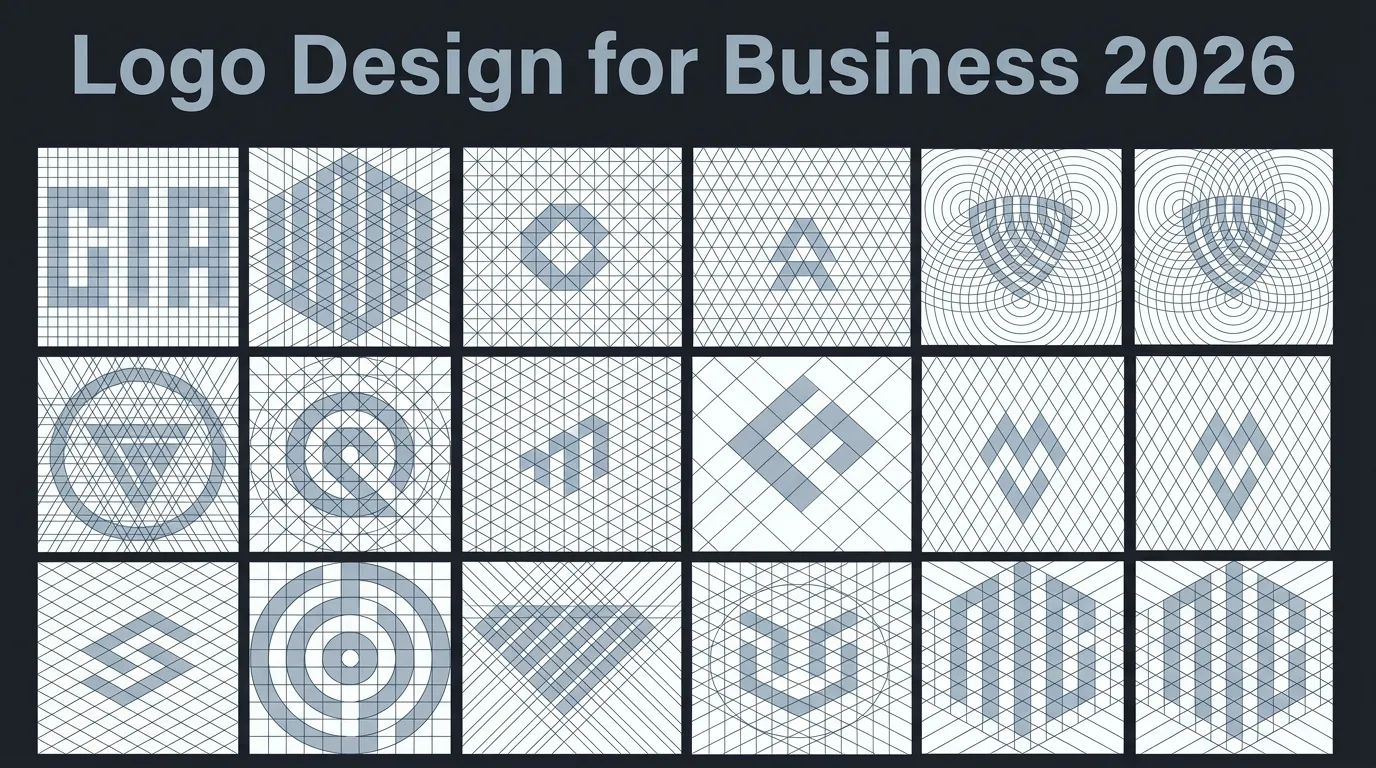
Most business owners either overthink their logo or barely think about it at all. Both approaches cost money. What actually matters in logo design for business is whether the mark works where your customers see it — on a Google listing, a social profile, a browser tab, an invoice — not whether it would win a design award.
This guide covers the strategic decisions behind getting a logo right: what makes one work, when to use an AI tool versus hiring a designer, how to write a brief that gets the right result, and what you should expect to pay in 2026.
Why Your Logo Is a Business Decision, Not a Design Decision
A logo is not art. It is a recognition tool.
Your customer sees your logo for fractions of a second — on a Google search result, a social media profile picture, an email signature, a business card. What they register in that moment is not the color theory or the negative space. They register whether your business looks trustworthy and professional.
Research consistently shows that users form a visual opinion about a website in under 50 milliseconds. Your logo is part of that first impression — not the whole thing, but a significant signal, especially for businesses without a recognizable brand name yet.
The question is not "do I like this logo?" The question is "does this logo do its job?" Its job is threefold: be recognizable, feel appropriate for the industry, and work in every format where your business appears. If it does all three, it is a good logo. If it fails at any one, it does not matter how many hours a designer spent on it.
Most logo conversations start with aesthetics — colors, fonts, shapes. The right conversation starts with function. Where will this logo appear most? Who needs to recognize it? What impression does it need to create in the first half-second? Start there, and the design decisions become far easier.
5 Things That Separate a Strategic Logo from a Template
There are five qualities that every effective business logo shares. These are not design opinions. They are functional requirements.
Simplicity. A logo needs to be recognizable at 16 pixels — the size of a browser favicon — and at three meters on a building sign. If a logo requires fine detail to make sense, it fails at small sizes. The Nike swoosh, the Apple silhouette, and the Target bullseye all pass this test. Print your logo at two centimeters wide on paper. If you cannot immediately tell what it is, it is not simple enough.
Relevance. A logo should feel appropriate for the industry and audience — without being literal. Penguin Books does not sell penguins. Shell's logo has nothing to do with oil extraction. What matters is that the mark feels congruent with the brand's positioning. A law firm needs a logo that communicates trust and authority. A children's toy brand needs one that communicates fun and energy. Neither needs a logo that literally depicts its product.
Versatility. A good logo works in full color, in a single color, on a white background, on a dark background, on a mobile screen, and on printed material. If a logo only looks right in one context, it will break in every other context it touches. Ask your designer for a black-and-white version early in the process. If the logo falls apart without color, the underlying form is too weak.
Distinctiveness. If your competitors all use blue circles with sans-serif type, your logo needs to be different enough that customers do not confuse you with them. Look at the five closest competitors in your market. If your logo could be swapped with any of theirs without anyone noticing, it is not distinctive enough.
Intentional typography. The typeface in your logo says something about your business whether you chose it deliberately or not. A rounded, friendly font says approachable. A thin, high-contrast serif says premium. A generic system font says the owner did not think about this. Typography carries meaning — treat it as a brand decision, not a default.
AI Logo Makers vs Professional Designers: When Each Makes Sense
This is the question most business owners actually have in 2026, and most logo articles avoid answering it honestly.
AI logo tools — Looka, Canva, Design.com, Namecheap — generate logos in minutes from a few inputs: your business name, your industry, your style preference. They are fast, cheap, and produce results that look polished enough on a screen.
They work in three specific situations. First, when you are testing a business idea before investing real money into branding. Second, when you need a placeholder logo for internal documents or a pitch deck that will be replaced later. Third, when the business is a side project that may not survive its first year.
They fall short in every other scenario. AI tools draw from shared template libraries, which means your logo will share visual DNA with thousands of other businesses using the same tool. They cannot account for how your logo needs to work across signage, packaging, embroidery, or print materials. And there is a legal dimension most people overlook: AI-generated designs may not qualify for copyright protection. The U.S. Copyright Office has issued guidance clarifying that works created without meaningful human authorship face significant registration challenges.
A professional designer is worth the investment when your business is past the testing phase. A designer does not just draw a mark — they research your market, study your competitors, consider your use cases, and build a visual system that works everywhere your brand appears. The logo you receive is not a file. It is the visible output of a strategic process.
The honest answer to "do I need a designer or can I use an AI logo maker?" is this: start with whatever makes sense for your stage. If you are pre-revenue, use an AI tool and spend the money on product development instead. When the business proves itself and revenue justifies the investment, hire a professional who will build something with staying power.
How to Write a Logo Brief That Gets the Right Result
A strong brief is the difference between a designer who delivers the right logo in two rounds and one who produces ten variations you hate.
Here is what to include in a logo design brief:
- Business name and what the business does — in plain language, not marketing copy
- Target customer — who they are, what they care about, and how they typically find you
- Brand personality — three adjectives that describe how you want your business to feel (for example: confident, modern, approachable — not "professional," which means nothing specific)
- Competitors — two or three businesses your customers might confuse you with, so the designer knows what to avoid replicating
- Applications — where the logo will appear most often (digital only? physical signage? product packaging? vehicle wraps? embroidered uniforms?)
- Existing assets — if you already have brand colors, a website, or previous logo versions the designer should be aware of
Here is what to leave out. Do not tell the designer what color to use before they have explored the concept. Do not request specific symbols — "I want a mountain and a sunrise" — because you are hiring a designer to solve the visual problem, not to execute your sketch. And never say "make it pop." That phrase communicates nothing actionable.
The best briefs describe the problem, not the solution. Tell the designer what impression the logo needs to create and who needs to respond to it. Let them figure out the visual answer. The fewer creative constraints you impose upfront, the better the concepts you will receive.
How to Tell If a Logo Is Actually Good
Most business owners evaluate a logo the wrong way — they ask whether they personally like it. Personal preference is not the right test. Here are five tests that are.
The memory test. Look at the logo for ten seconds, then close the file and wait five minutes. Can you sketch it roughly from memory? If yes, it is simple enough to be memorable. If you cannot recall the basic shape, the design is too complex for real-world recognition.
The monochrome test. Strip all color from the logo and view it in pure black and white. If the logo loses its identity without color, the underlying form is not strong enough. Color should enhance a logo, not define it. Every strong mark in history works in a single color.
The scale test. View the logo at 16 pixels wide — favicon size — and at full width across a browser window. Both versions should be clearly recognizable. A logo that only works at one size will break in real applications, and you will spend years working around it.
The context test. Place the logo on a white background, a dark background, and over a photograph. Does it hold up in all three contexts? Many logos are designed and approved on white, then fail the moment they appear on a dark website header or a colored business card.
The competitive test. Line up the logo next to three direct competitors in your market. Does it stand out or blend in? If someone scrolling past a list of businesses in your category would not pause on yours, the logo is not doing its primary job — differentiation.
If a designer presents a logo and cannot explain the reasoning behind each decision — why that typeface, why that form, why that proportion — ask them. A strategic logo has a reason for every element. A template does not.
What Business Logo Design Costs in 2026
Price ranges vary widely because "logo design" can mean very different things depending on who is doing the work.
- AI logo generators: Free to $100. You get a generated mark in common file formats. No strategy, no custom concepts, no guarantee of uniqueness or copyright ownership.
- Junior freelance designer: $200 to $800. You typically get two to three concepts with a few rounds of revisions. Quality depends entirely on the individual designer's skill and experience.
- Experienced freelance designer: $800 to $3,000. You get a strategic process — market research, multiple concepts, structured revisions, and final delivery in all necessary formats. This is where most established small businesses should land.
- Design studio or agency: $3,000 to $15,000 and above. You get a complete brand identity system — logo, typography, color palette, brand guidelines, and often application design including business cards, social templates, and signage specifications.
What you are paying for is not a file. You are paying for research, strategic thinking, concept development, revision rounds, and delivery in every format your business needs — SVG, PNG with transparent background, dark and light versions, social media dimensions, and print-ready files.
A $300 logo and a $3,000 logo might look similar on screen. The difference is in the process behind them: whether someone studied your market before opening a design tool, whether the logo was tested at multiple sizes and across different backgrounds, and whether you received files that actually work in every real application your business encounters.
What to Do After You Get Your Logo
Getting the logo is not the last step. How you use it in the first six months determines whether it builds recognition or gets forgotten.
Collect every file format you need. At minimum: SVG for scalable vector use, PNG with transparent background in both light and dark versions, and the hex color codes for every color in the logo. If you plan to use the logo in print, request CMYK color values and a vector PDF file from your designer.
Create basic brand guidelines. Even a single-page document protects your logo from slow distortion. Include: logo clear space requirements, minimum display size, approved color variations, and explicit instructions on what not to do — do not stretch it, do not change the colors, do not add drop shadows or effects. This prevents well-meaning employees and vendors from gradually degrading your brand.
Apply it everywhere, consistently. Update your website, social profiles, email signature, invoices, proposals, and any physical materials. A logo that appears differently in ten places is ten logos, not one. Consistency across every touchpoint is what builds recognition over time.
Do not redesign for at least two to three years. Every time you change your logo, you reset your customer's recognition to zero. Give the mark time to do its job before judging whether it is working.
When Your Business Needs More Than a Logo
A logo is one component of how your business looks and feels to customers. It works best when it is part of a system — a website, a color palette, a tone of voice, a consistent experience across every place a customer encounters your brand.
If you are building a new website, launching a product, or repositioning your business, the logo is just the starting point. The real question is whether your entire digital presence works together to build trust and convert the right visitors.
If you want your logo, website, and brand identity working as one system — see how Vediwood approaches web design projects. No templates. No guesswork. Built around how your customers actually find and trust your business.
Follow Us
Most founders read us once and change something that week.
Every issue covers one thing that makes your website work harder — better conversion, stronger SEO, or smarter design. No fluff, no agency speak. Just the decision you need to make this week.
Our Team

Sadiki Said
Full Stack Developer

Nezha Essyed
Content Strategist