A/B Testing for Small Business Websites in 2026
Most A/B testing guides assume you have enterprise traffic and a developer on hand — most small businesses have neither. This is the plain-language guide to testing on a real budget: what to test first, which 2026 tools to use, and how to know your result is actually real.

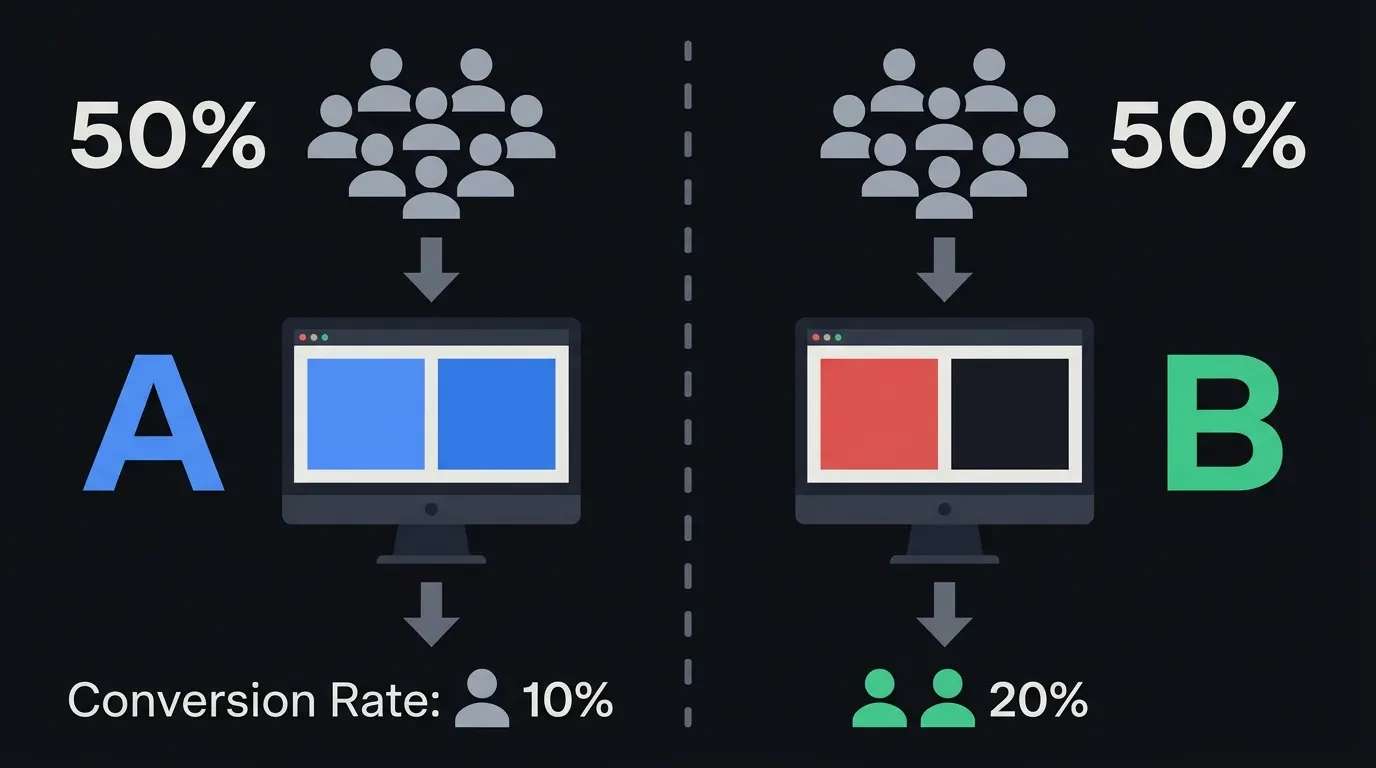
A/B testing for small business websites works — but only if you have enough traffic to trust the result, and most guides skip that part entirely. You can still test smart: start with the changes that matter most, lean on 2026 tools that do the heavy lifting, and know when your traffic isn't ready yet. This guide walks through all of it — whether you're ready, what to test first, which tools fit a small budget, and what to do when the traffic is thin.
A/B Testing for Small Business Websites: Do You Have Enough Traffic?
Most small business owners ask the wrong first question. They ask “what should I test?” when the real question is “do I have enough traffic to trust any test at all?” Get that wrong and you’ll spend a month staring at numbers that mean nothing.
Here’s the honest threshold. You need roughly 100 conversions per version before a result is trustworthy — not 100 visitors, but 100 actual sales, sign-ups, or whatever you’re counting. Experienced testers put the same number at 100 to 150 conversions per variant, and they’re right.
Now do the math on your own site. If your landing page gets 2,000 visitors a month and converts at 2%, that’s 40 conversions — split across two versions, just 20 each. A reliable test would take you two to three months, which is usually too slow to be worth it.
That doesn’t mean A/B testing is off the table for you. It means you test bigger changes, on your highest-traffic pages, and you read the next few sections before you touch anything. Small sites can absolutely test — they just can’t test the way the enterprise guides describe.
What A/B Testing Actually Is (in Plain Terms)
A/B testing — also called split testing — means showing two versions of the same page to different visitors at random and measuring which one gets more conversions. Version A is what you have now. Version B is the one change you want to try.
The key word is one change. You swap a single element — a headline, a button color, the order of your form fields — and keep everything else identical. When one version wins, you then know exactly what caused it.
This is the opposite of a redesign. A redesign changes a hundred things at once and leaves you guessing which one helped or hurt. A/B testing trades speed for certainty, and for a small business, certainty is what protects a tight budget from an expensive guess.
It also isn’t guesswork dressed up in software. The whole point is to replace “I think the green button looks better” with “the green button earned 18% more clicks across 1,200 visitors.” The upside is real and measured: Microsoft once found that a single, long-ignored headline change on Bing lifted revenue by 12% — around $100 million a year — from one quick test (Harvard Business Review, 2017). You won’t see Bing-sized numbers, but the principle scales down to a small site just fine.
How Much Traffic You Really Need to Trust a Result
The number that matters is statistical significance — the odds your result is real and not random luck. Most testing tools aim for 95% confidence, which is the standard for calling a winner. Below that, you’re flipping a coin and congratulating yourself when it lands your way.
Three things decide how long a test takes: your traffic, your current conversion rate, and the size of the change you’re trying to measure. Low traffic plus a tiny improvement is the worst combination — it can drag on for months without ever reaching 95%. Big changes on busy pages resolve the fastest.
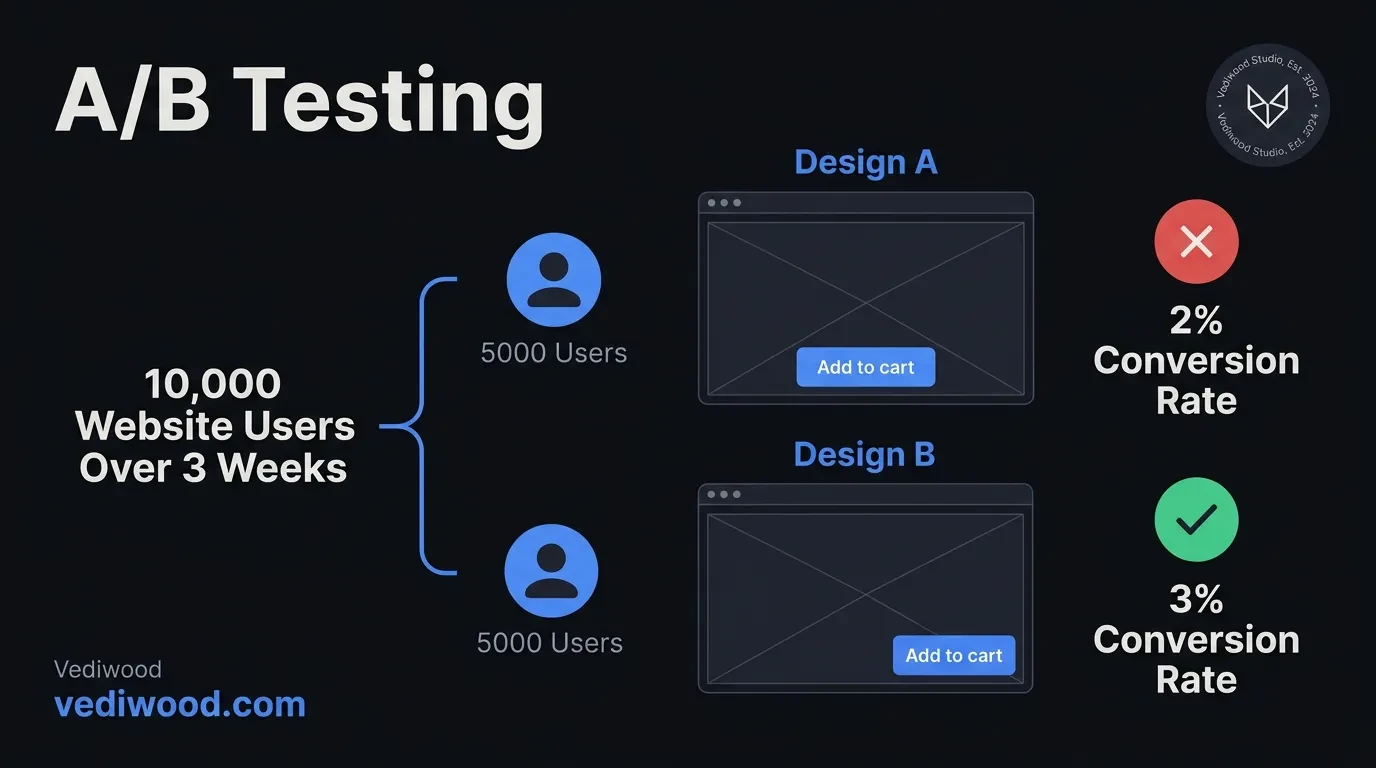
A rough planning rule keeps you honest. To detect a 20% relative lift on a page that converts around 3%, you’ll need roughly 3,000 to 5,000 visitors per version. Free sample-size calculators from VWO and Optimizely give you the exact number in seconds — plug in your conversion rate and your target lift before you start, not after.
The lesson isn’t “give up if you’re small.” It’s “size the test before you run it.” If a test can’t realistically finish inside four to six weeks on your traffic, it’s the wrong test for your site — pick a bolder change or a busier page.
What to Test First on a Small Business Website
When traffic is limited, you don’t test everything — you test the few things that change behavior most. Start where the money is: the pages closest to the sale or the lead. Your homepage hero, your main call-to-action, and your checkout or contact form are the three highest-leverage tests for most small sites.
Test these elements in roughly this order:
- Headline and value proposition — the first thing visitors read, and usually the single biggest lever on a page. A clearer promise almost always beats a cleverer one.
- The primary call-to-action — button text, color, and placement. “Get my free quote” reliably beats “Submit,” because it names the value instead of the action.
- The form — every field you remove lifts completion. Test a 3-field form against your current 6-field one and watch what happens.
- Social proof placement — moving reviews or client logos above the fold can build trust before the visitor has to scroll for it.
- Hero image vs. no image — big images look nice, but they can slow the page and push your actual offer down below the fold.
Notice what’s missing from that list: font choices, minor color shifts on quiet pages, and anything below the fold on a page nobody scrolls. Those are real changes, but they move the numbers too little to ever reach significance on a small site. Spend your limited traffic on the tests that can actually produce a winner.
The Best A/B Testing Tools for Small Business in 2026
The right tool depends on two things: your budget and whether you have a developer. Here’s the honest breakdown for a small business in 2026 — not an enterprise with a dedicated growth team.
Free or low-cost, no developer needed:
- VWO — its free plan handles one test at a time, which is exactly right when you’re starting out. Visual editor, no code required.
- Statsig — a genuinely capable free tier covering A/B and multivariate tests with audience segmentation. A favorite of small, technical teams.
- Crazy Egg — pairs simple tests with heatmaps, so you can see where people actually click while you test.
Already built into your platform:
- If you’re on Shopify, Wix, or HubSpot, native A/B testing is already sitting in your dashboard. For most small stores that’s plenty — start there before you pay for anything separate.
The 2026 shift — AI-assisted testing:
- VWO, Optimizely, and Statsig have all added AI features that suggest what to test, draft the variation copy, and call winners earlier using smarter statistics. For a small business, the real value of AI testing is that it lowers the skill barrier — you no longer need a CRO specialist on staff to design a sound experiment.
One caution from building real sites: every third-party testing script adds weight to your page. Pick an asynchronous, lightweight tool and keep an eye on your load time, because a slow test page quietly costs you the conversions you’re trying to win. And don’t worry about your rankings — Google’s own guidance confirms A/B testing is fine as long as you show the same content to visitors and Googlebot, and use temporary redirects, not permanent ones (Google Search Central).
How to Read Your Results Without Fooling Yourself
The fastest way to waste a test is to call it early. You peek on day three, version B is up 30%, you ship it — and the lift vanishes within a week. Early results lie, because small samples swing wildly before they settle.
Wait for two things before you trust a winner: 95% statistical significance and a full business cycle. A full cycle means at least one complete week, so both weekday and weekend behavior get counted. Many small-site tests need two to four weeks to get there.
Then look past the headline metric. Here’s the trap most guides skip: a version can win on click-through but lose on actual sales, because it pushes more people into carts they abandon. Always check the conversion that pays you — revenue, booked calls, completed orders — not just the click that feels good on a dashboard.
And accept the most common outcome. Most tests show no clear winner, and that isn’t failure — it tells you the change didn’t matter, so you stop arguing about it internally and move on to a bigger test. A flat “no difference” result still earned its keep: it saved you from a redesign nobody needed.
What to Do When You Don’t Have Enough Traffic Yet
If the math says you can’t run a clean test, don’t fake one — you’ll end up making confident decisions on pure noise. This is the situation most guides ignore, and it’s where most small businesses actually live. Here’s what works instead.
Test bigger, bolder changes. A radical difference between A and B produces a larger effect, and a larger effect needs less traffic to detect. Test a completely different headline and offer, not a single button shade.
Use qualitative tools that need no sample size. Heatmaps, session recordings, and a short on-site survey tell you where people get stuck with as few as 50 visitors. Tools like Microsoft Clarity (which is free) and Hotjar show you the friction directly, no statistics required.
Run a sequential test instead. Change one thing for everyone for two weeks, measure, then switch it back and compare the two periods. It’s less rigorous than a true split test, but on a low-traffic site it beats waiting six months for significance that may never arrive.
Then put your real effort into traffic. A/B testing only pays off once you have visitors to test on. Until you do, your highest-return work is SEO, content, and getting the page fundamentals right — fast load, one clear message, and a single obvious action. Fix those first, and your future tests will resolve far faster.
Where to Take This Next
A/B testing rewards businesses that build it in, not bolt it on. If your site is slow, hard to edit, or wired so you can’t change a headline without a developer, testing will always feel heavier than it should — so you’ll quietly skip it.
That’s a build problem, not a testing problem. The sites that improve fastest are the ones designed to be tested — fast to load, modular, and easy to change one piece at a time.
If you want a site built that way from the ground up — quick to edit, fast enough to test on, and structured so every change is measurable — see how Vediwood approaches a build. No templates, no guesswork — just a site you can actually keep improving.
Follow Us
Most founders read us once and change something that week.
Every issue covers one thing that makes your website work harder — better conversion, stronger SEO, or smarter design. No fluff, no agency speak. Just the decision you need to make this week.
Our Team

Sadiki Said
Full Stack Developer

Nezha Essyed
Content Strategist