Dark Patterns in UX: The Hidden Legal Risk
Dark patterns can turn a normal checkout or signup into a legal liability, and most business owners have no idea theirs are there. This guide shows you how to spot dark patterns in UX, what they now cost under EU, UK, and US law, and how to fix them without losing sales.

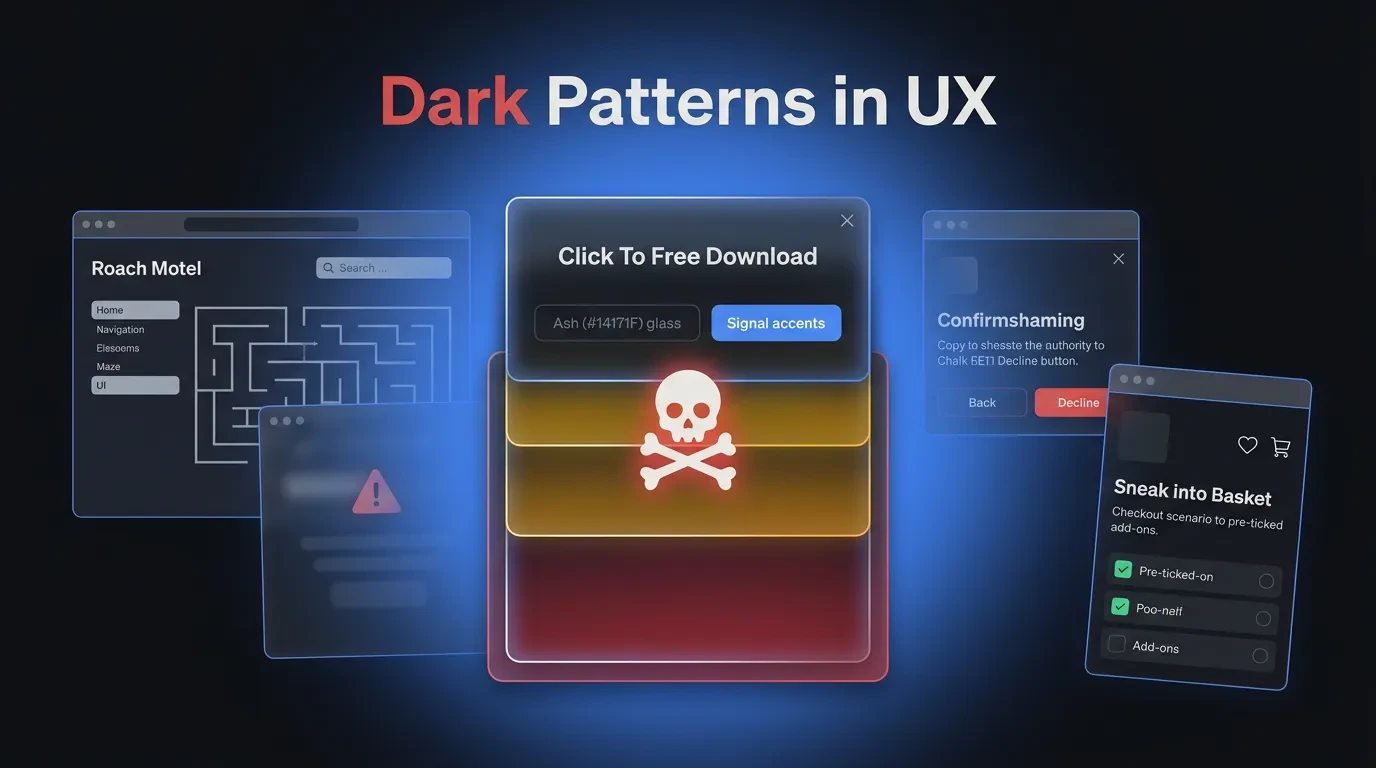
In September 2025, the FTC took $2.5 billion from Amazon — not for what it sold, but for how its interface was built. That is the new reality of dark patterns in UX: design choices that push users into actions they never meant to take are now a legal and financial liability. Most business owners running them have no idea they are there. They inherited a template, copied a competitor’s checkout, or left a “limited stock” banner running long after it was true. This guide shows you how to find those patterns on your own site and remove them before they cost you.
What Dark Patterns Actually Are — and Why Yours Might Be Accidental
A dark pattern is a design choice that benefits the business by making the user’s better choice harder to find or harder to make. The UK designer Harry Brignull coined the term in 2010, and the industry now often calls them “deceptive patterns” — because the defining trait is deception, not aggression. A loud sale banner is persuasion. A pre-ticked insurance box you have to notice and uncheck is deception.
The line between persuasion and a dark pattern is intent and honesty. Showing real social proof or a genuine discount is fair play. Hiding the cancel button, sneaking a fee in at the last step, or wording a checkbox as a double negative is not.
Most dark patterns on small business sites are not the work of a villain. They arrive through copied checkouts, plugin defaults, and “best practice” advice that optimizes for one number. That is exactly what makes them dangerous: they look normal.
The Dark Patterns Most Likely Hiding on Your Site Right Now
You do not need a catalog of thirty patterns. A handful show up again and again on ordinary business websites, and these are the ones regulators and customers notice first.
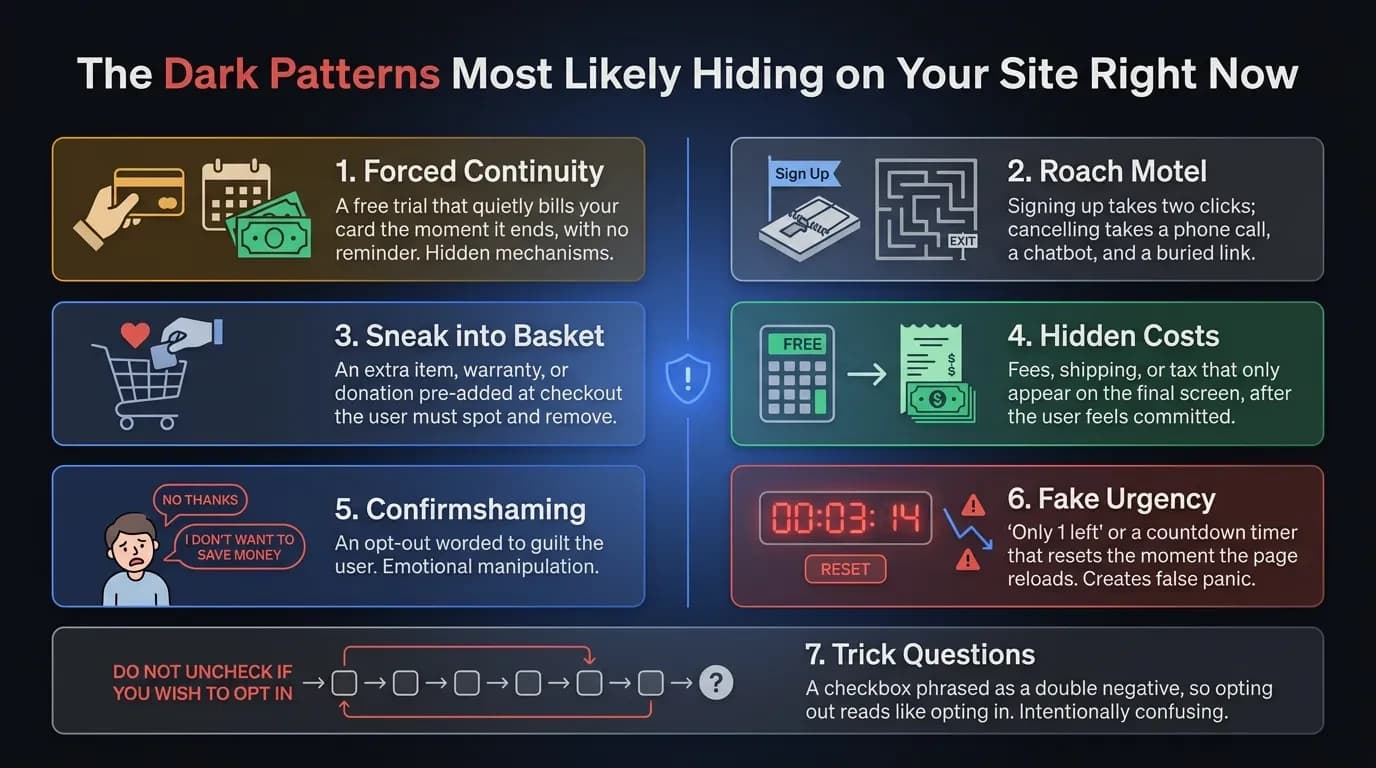
- Forced continuity — a free trial that quietly bills the card the moment it ends, with no reminder.
- Roach motel — signing up takes two clicks; cancelling takes a phone call, a chatbot, and a buried link.
- Sneak into basket — an extra item, warranty, or donation pre-added at checkout that the user has to spot and remove.
- Hidden costs — fees, shipping, or tax that only appear on the final screen, after the user feels committed.
- Confirmshaming — an opt-out worded to guilt the user: “No thanks, I don’t want to save money.”
- Fake urgency — “Only 1 left” or a countdown timer that resets the moment the page reloads.
- Trick questions — a checkbox phrased as a double negative, so opting out reads like opting in.
If you run an e-commerce store or a subscription, you almost certainly ship at least one of these. The fix usually takes an afternoon. The risk of leaving it in place does not.
Why Dark Patterns Are Now a Legal Liability, Not Just a UX Sin
For most of the last decade, dark patterns were an ethics debate among designers. That window has closed. Across the US, EU, and UK, the same design choices are now written into law as illegal.
In the EU, the Digital Services Act bans deceptive interface design outright, and the fines reach up to 6% of a company’s global annual turnover. The Digital Services Act sits on top of the GDPR, which already made consent obtained through manipulation invalid. For a platform of any size, that is a real number, not a slap on the wrist.
The UK followed in April 2025. Its Digital Markets, Competition and Consumers Act now treats hidden fees, fake urgency, and fake reviews as banned commercial practices, with penalties that can reach 10% of global turnover.
In the US, the FTC enforces against dark patterns under its deception authority. Its 2022 report, Bringing Dark Patterns to Light, named the exact tactics above — and in September 2025 it secured a $2.5 billion settlement from Amazon over how Prime handled sign-up and cancellation.
One caveat worth knowing: the FTC’s “Click to Cancel” rule was struck down by a federal appeals court in July 2025. The rule itself is gone, but the enforcement is not — the FTC still pursues hard-to-cancel flows as deception, case by case. India went further still, with its consumer authority banning 13 named dark patterns in 2023. If you sell across borders, the strictest rule is the one that applies to you.
What Dark Patterns Actually Cost You Beyond the Fine
A fine is the headline. The quieter cost is the one that shows up in your reviews and your churn rate.
People rarely forget the moment they felt tricked. A 2024 international sweep by ICPEN reviewed 642 subscription services and found 76% used at least one dark pattern — which means your customers have seen these tricks everywhere and have learned to resent them.
When a customer catches the trick, they do not just leave quietly. They warn other people, in a review, a Reddit thread, or a screenshot that travels further than any ad. One viral cancellation story can undo months of paid acquisition.
Dark patterns also poison the metric they are meant to help. A signup driven by a sneaked-in fee becomes a refund, a chargeback, or an angry cancellation. That is revenue that looked real for a week and then reversed.
How to Audit Your Site for Dark Patterns in UX in One Afternoon
You do not need a consultant to find most of this. Sit down as if you were a first-time customer, walk your own funnel, and hold one question in your head: where is the better choice being hidden?
- Run the cancellation, not just the signup. Time how long it takes to cancel or downgrade. If leaving is harder than joining, you have a roach motel.
- Watch the final checkout screen. Note any fee, add-on, or pre-ticked box that only appears at the end. Move it earlier, or remove it.
- Read every opt-out out loud. If declining sounds like an insult or twists into a double negative, rewrite it as a plain “No thanks.”
- Check your urgency claims. If “Only 2 left” or a countdown is not literally true, it is now a banned practice in the UK and EU. Make it real or delete it.
- Test it on mobile. Many dark patterns hide in the small-screen layout — a decline button pushed below the fold, a close icon that is almost impossible to tap.
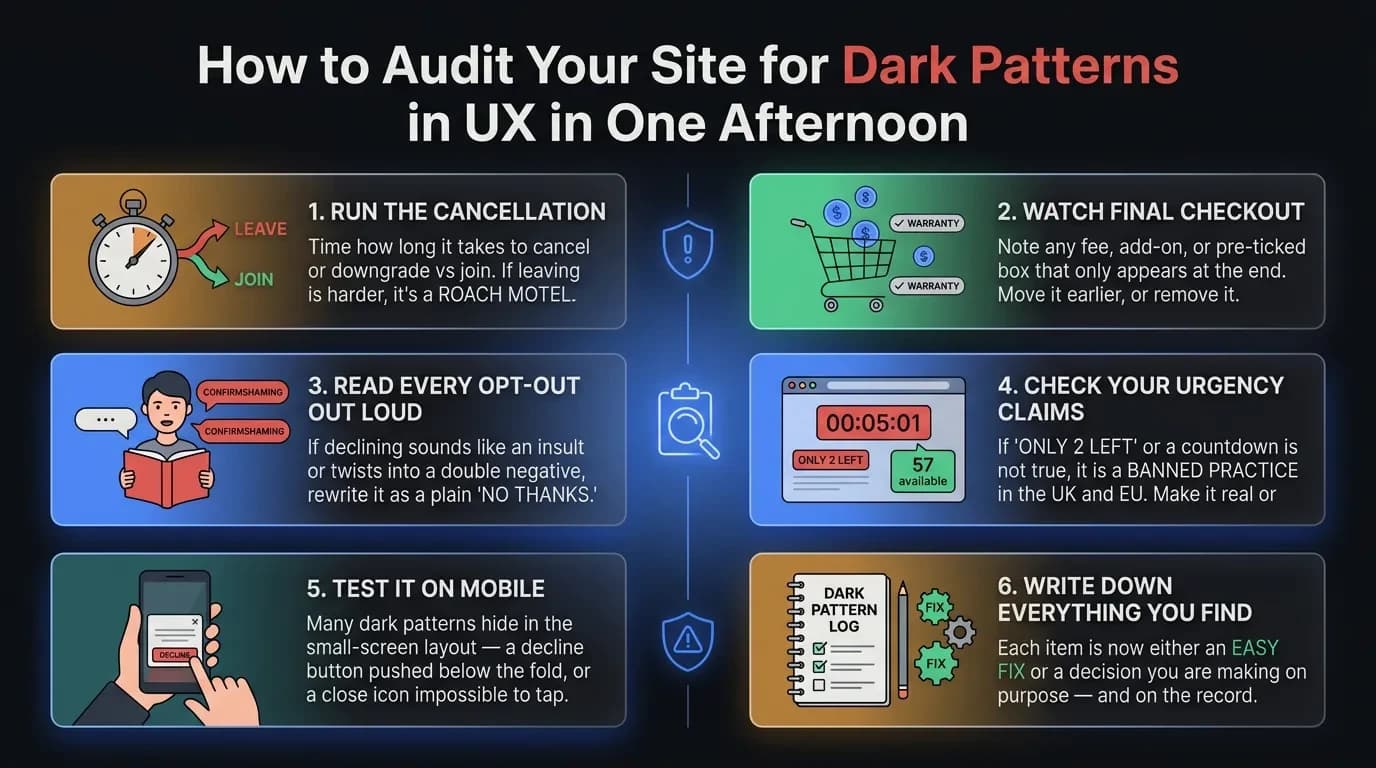
Write down everything you find. Each item is now either an easy fix or a decision you are making on purpose — and on the record.
What to Build Instead — Ethical Design That Still Converts
Removing dark patterns does not mean removing persuasion. It means making the honest path the easy one.
Replace forced continuity with a genuine reminder email before a trial ends — it lowers refunds and chargebacks at the same time. Replace a buried cancel link with one-click cancel, the standard regulators now expect anyway.
Replace fake scarcity with real scarcity, or with a real reason to act now — a true deadline, an honest stock count, a genuine bonus. People respond to honesty when it is specific.
In our experience building e-commerce sites, the honest version usually wins on the numbers that matter: fewer refunds, fewer support tickets, more repeat purchases. Trust is the only conversion that compounds.
But Dark Patterns Boost Conversions — Isn’t Removing Them a Loss?
This is the objection every founder raises, and it is fair. Dark patterns do lift the top-of-funnel number. The problem is what that number turns into.
A conversion you tricked someone into is a liability on a delay. It comes back as a refund, a chargeback, a one-star review, or — at scale — a letter from a regulator.
The businesses that win the long game treat the funnel as a relationship, not a single transaction. You are not choosing between conversions and ethics. You are choosing between a number that holds and a number that quietly reverses.
Find the Dark Patterns Before a Customer Does
If you are not sure whether your own checkout or signup is quietly costing you trust, that is worth knowing before a regulator or a reviewer points it out for you. See how Vediwood designs and builds sites with this baked in — conversion that holds up because it is honest, not in spite of it.
Follow Us
Most founders read us once and change something that week.
Every issue covers one thing that makes your website work harder — better conversion, stronger SEO, or smarter design. No fluff, no agency speak. Just the decision you need to make this week.
Our Team

Sadiki Said
Full Stack Developer

Nezha Essyed
Content Strategist