Google Business Profile Optimisation: Map Pack 2026
A complete Google Business Profile no longer ranks you in the map pack — the November 2025 update changed what counts. This is the plain-English guide to Google Business Profile optimisation for small business: what to fix first, and what actually moves you up.

You filled out every field on your Google Business Profile, added photos, and asked for a few reviews — and you still aren't showing up in the map pack. That is the most common frustration small business owners have with local search right now. The hard truth is that a complete profile stopped being enough in late 2025. Google Business Profile optimisation for small business is now about signals you cannot see in the dashboard: how fast reviews come in, how people interact with your listing, and how Google's AI reads it. Here is what actually moves your ranking — and what to fix first.
What actually ranks a small business in the map pack
Google ranks local results on three factors, and it says so openly: relevance, distance, and prominence. Relevance is how well your profile matches the search. Distance is how close you are to the person searching. Prominence is how well-known and active Google thinks your business is.
You cannot change where your customer is standing. You can change the other two — and prominence is where most small businesses leave rankings on the table.
In 2026, prominence is no longer about who has the oldest listing or the most backlinks. It is about recent, real activity: reviews arriving steadily, people clicking and calling, and a profile that Google's systems can read and summarise. Get those right and you can outrank businesses that have been around far longer than you.
What changed in Google's November 2025 update
If your rankings slipped over the last few months, you are not imagining it. The November 2025 update shifted weight toward signals that prove a business is active and trusted right now — not just complete on paper.
Three changes matter most for a small business:
- Review velocity — a steady stream of recent reviews now counts for more than a large pile of old ones.
- Engagement signals — clicks, calls, direction requests, and messages from your listing feed back into your ranking.
- AI-generated summaries — Google increasingly shows an AI-written summary of your business, pulled from your profile, reviews, and website.
The old playbook was simple: claim it, fill it in, forget it. That playbook is now actively working against you. A profile that was perfect in 2023 and untouched since is losing to a newer competitor who posts every week and earns a handful of reviews a month.
Complete your profile foundation first
None of the new signals help if the basics are wrong. The foundation still decides whether you are even eligible to rank.
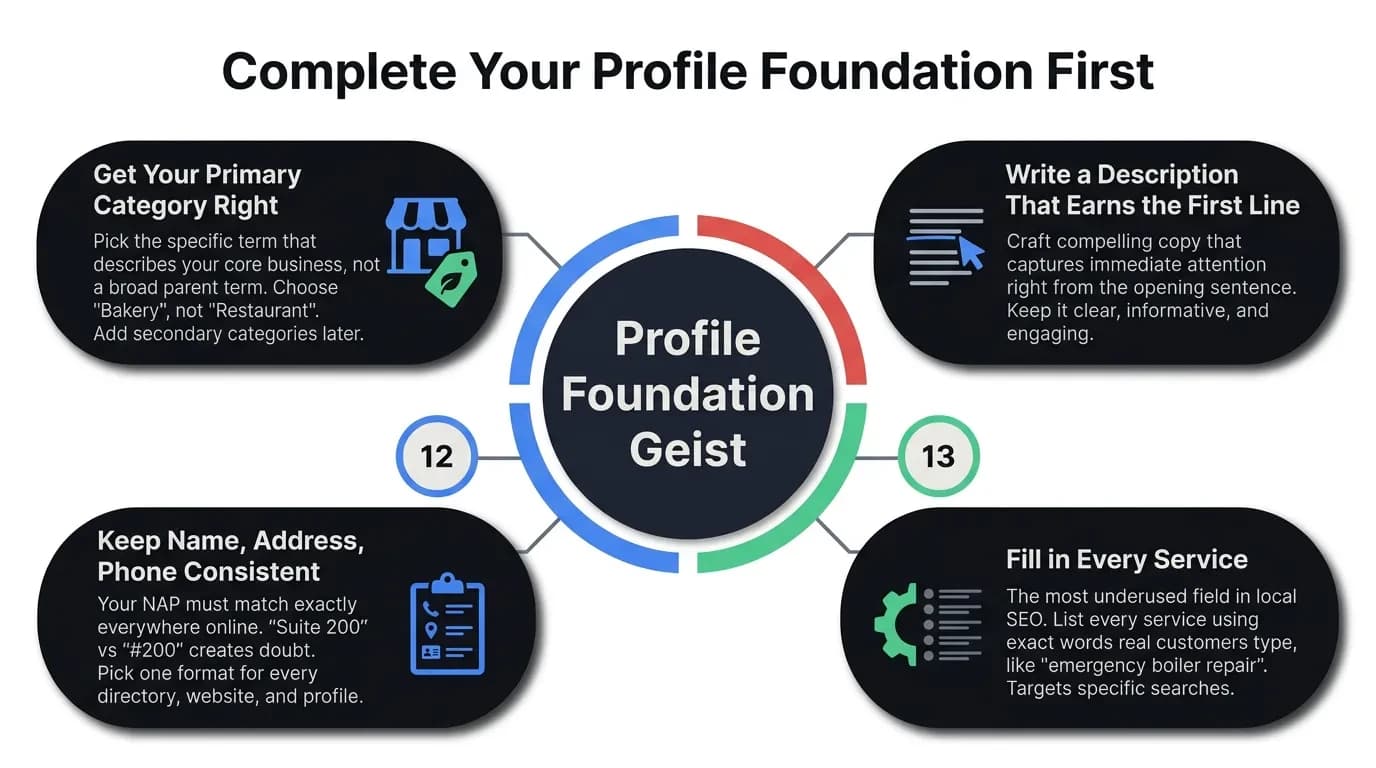
Get your primary category right
Your primary category is one of the strongest relevance signals you control. Pick the one that describes your core business, not a broad parent term. A bakery should choose "Bakery", not "Restaurant", then add secondary categories for the other things it does.
Keep your name, address, and phone consistent
Your name, address, and phone number — your NAP — must match exactly everywhere they appear online. A "#200" on Google and a "Suite 200" on Yelp is enough to create doubt. Pick one format and use it on every directory, your website, and your social profiles.
Fill in every service
The services section is the most underused field in local SEO. List every service using the words real customers type — "emergency boiler repair", not just "repairs". These phrases help you appear for specific searches you would never rank for otherwise.
Write a description that earns the first line
You get 750 characters, and most businesses waste them. Lead with who you are, what you do, and where you do it — the first 250 characters carry the most weight. Write for a person, work in your main service and city naturally, and skip the keyword stuffing Google ignores anyway.
Reviews are now your biggest lever
Reviews moved from "nice to have" to the single biggest factor you can influence. After the November 2025 update, how recently and how steadily you earn reviews matters as much as how many you have.
A business with 40 reviews earned over the last year now often outranks one with 300 reviews that stopped arriving two years ago. Google reads a steady flow as proof you are active and trusted today, not just popular in the past.
Make review requests part of the job, not an afterthought. Send the request within a day of the work, while the experience is fresh, and use Google's own short review link to remove every bit of friction. Aiming for two or three genuine reviews a month beats a one-time burst that looks unnatural.
Then respond to every review, fast. A reply within 24 hours — especially to a negative one — signals an engaged business and gives you a natural place to mention your service and city. Generic "Thanks!" replies waste the chance; a sentence that names what you did is worth far more.
The engagement signals most owners ignore
Google now watches what people do with your listing, not just what is on it. Every call, direction request, click to your website, and message is a vote that your business is the right answer to the search.
You cannot fake engagement, but you can earn more of it:
- Post weekly. Use Google Posts for offers, events, and updates. Fresh posts show activity and give people a reason to click through.
- Add photos regularly. Listings with current photos get more clicks and direction requests. Upload real shots of your work, your team, and your location — not stock images.
- Answer questions. Monitor the Q&A section and reply quickly. You can even add your own common questions and answer them clearly.
- Turn on messaging only if you can reply fast. A missed message hurts you more than having no messaging at all.
The pattern Google rewards is simple: a profile that looks lived-in, kept up by a real business that shows up every week.
How to get your business into Google's AI summaries
Google now writes AI summaries of local businesses and surfaces them across Search and Maps. These summaries pull from your profile, your reviews, and your website — so the clearer your information, the more accurate the summary.
To give the AI good material to work with:
- Keep your profile facts specific and current — hours, services, and attributes.
- Make sure your website says plainly what you do and where, in normal sentences a person would actually use.
- Encourage reviews that mention specific services and outcomes, because the AI quotes the language your customers use.
You can read how Google's systems use this content in its AI features guidance for Search. The takeaway for a small business is straightforward: write for clarity, and the AI can represent you accurately instead of guessing.
The mistakes that quietly tank your ranking
Most ranking problems are not about doing too little. They are about small things that send Google the wrong signal.
The ones we see most often:
- Keyword-stuffing your business name. Adding "Best Plumber London" to your name breaks Google's rules and can get your profile suspended.
- A fake or unstaffed address. Virtual offices and PO boxes do not hold up — competitors report them and Google removes them.
- Inconsistent NAP across directories, which splits the trust signals that should be reinforcing each other.
- Letting the profile go quiet — no posts, no new photos, and no recent reviews for months on end.
- Ignoring negative reviews, which tells both Google and customers that nobody is home.
Fix these before you chase anything advanced. A clean, consistent, active profile beats a clever one every time.
How to track whether it's working
You do not have to guess whether your effort is paying off. Google's built-in performance view shows how people find you, what they searched, and what they did next — calls, direction requests, and website clicks.
Watch three things each month: whether you appear for your target searches, whether calls and direction requests are trending up, and whether reviews keep arriving. Those numbers tell you more than your ranking on any single day, which moves around constantly.
If calls and clicks are climbing but your map pack position is not, the problem is usually distance or a stronger competitor — not your profile. That is when the work shifts to your website and local content.
How long Google Business Profile optimisation takes
This is the question every owner asks, so here is an honest answer. The foundation — categories, NAP, services, and description — you can fix in an afternoon, and it can affect your eligibility within days.
The signals that move you up the map pack take longer. Review velocity, engagement, and consistent posting need a few weeks to a few months to show a clear change, because Google is measuring a trend rather than a single action.
The businesses that win treat it as a habit, not a project. Thirty minutes a week — one post, a few review requests, and a quick reply to every review — beats a one-time overhaul that is left to gather dust.
Get your profile and your site telling the same story
Local SEO works best when your Google Business Profile and your website tell Google the same clear story. If your profile is doing its job but your site lets it down — slow to load, unclear, or vague about what you do and where — that is the gap that holds your rankings back. See how we build small business sites that rank locally, from the profile to the pages behind it.
Follow Us
Most founders read us once and change something that week.
Every issue covers one thing that makes your website work harder — better conversion, stronger SEO, or smarter design. No fluff, no agency speak. Just the decision you need to make this week.
Our Team

Sadiki Said
Full Stack Developer

Nezha Essyed
Content Strategist