Local SEO for Service Area Business: Rank With No Address
Google's local results were built for businesses with a front door — and yours doesn't have one customers visit. Here's exactly how plumbers, cleaners, coaches, and mobile services rank in local search without ever showing an address.

You can rank in local search without a physical address — Google built an entire system for businesses like yours. It's called a service area business profile, and plumbers, cleaners, consultants, and mobile services use it every day to show up on Google Maps without a storefront. Local SEO for a service area business isn't a watered-down version of "real" local SEO. It's a different game with different rules, and most guides skip the parts that matter once your address is hidden. This one doesn't.
Yes, You Can Rank on Google Maps Without a Storefront
Google calls a business like yours a service area business: one that travels to its customers instead of serving them at a fixed location. Plumbers, electricians, house cleaners, mobile detailers, dog groomers, personal trainers, delivery services, consultants who meet clients on-site — all eligible. This isn't a workaround or a loophole; it's a profile type Google designed on purpose.
Here's how it works. You verify your real address with Google privately — usually your home or office — so Google can confirm you're a real business and not a spam listing. Then you hide that address from the public profile and define the areas you serve instead.
Your profile appears in search results and on Maps showing your service area, not a pin at your house. You compete in the same map pack as businesses with storefronts, for the same searches, under the same algorithm. The address question is settled — the real work is everything that comes after.
One warning before you touch anything: do not fake a storefront to "solve" this. Virtual offices, P.O. boxes, and coworking addresses without permanent signage are among the most common triggers for profile suspensions, and a suspended profile can take weeks to recover while your phone stays silent.
How Local SEO for a Service Area Business Actually Works
Google ranks local results on three factors: relevance (how well you match what was searched), distance (how close you are to the searcher), and prominence (how well-known and well-reviewed you are). Google's own documentation lists all three openly. For a service area business, distance is the uncomfortable one — Google still measures proximity from your verified address, even though nobody can see it.
And proximity is heavy. In Whitespark's 2026 Local Search Ranking Factors report, Google Business Profile signals carry roughly 32% of map pack ranking weight, and proximity to the searcher sits at the very top of that category (Whitespark, 2026).
So here's the honest strategy this whole guide is built on: you cannot beat proximity, so you out-earn it on relevance and prominence. A cleaner twelve miles away with 200 recent reviews, a complete profile, and a strong website beats a cleaner two miles away with a hollow listing — not every time, but often enough to build a business on.
Every tactic below feeds one of those two levers. Relevance comes from your profile setup and your website. Prominence comes from reviews and consistent mentions of your business across the web.
Set Up Your Google Business Profile the Service-Area Way
Your Google Business Profile is the engine of everything else, and service area businesses set it up differently from shops. Work through these steps in order.
Create or claim your profile, and when asked about your location, choose the option for delivering goods and services to customers — then clear the public address field. If your profile already exists with a visible address, you can switch it in your business information settings.
Verify with your real address. Google still needs it privately. Verification methods vary — video verification is now the most common for service businesses, so be ready to show your vehicle, tools, or workspace.
Set your service areas. Google lets you add up to 20 areas — cities, postcodes, or counties — and officially recommends keeping them within about a two-hour drive of your base. Listing half the country doesn't expand your reach; it dilutes your relevance and invites suspension reviews.
Choose your primary category with care. Whitespark's 2026 data puts the primary category among the strongest individual ranking factors you control. "House cleaning service" and "Janitorial service" rank for different searches — pick the one that matches the jobs you actually want.
Fill in every service with a description. Each service you list is a relevance signal for a search you could appear in.
Upload real photos monthly. Job sites, before-and-afters, your branded van, your team. Stock photos signal nothing; real ones signal an active business.
Your business name must be your real-world name — nothing more. "Reyes Plumbing" is safe; "Reyes Plumbing | Best Cheap Plumber Austin TX" is a suspension waiting to happen. Keyword-stuffed names, duplicate listings, and fake addresses are the three traps that take service businesses off the map entirely.
Build Service Area Pages That Help Instead of Doorway Spam
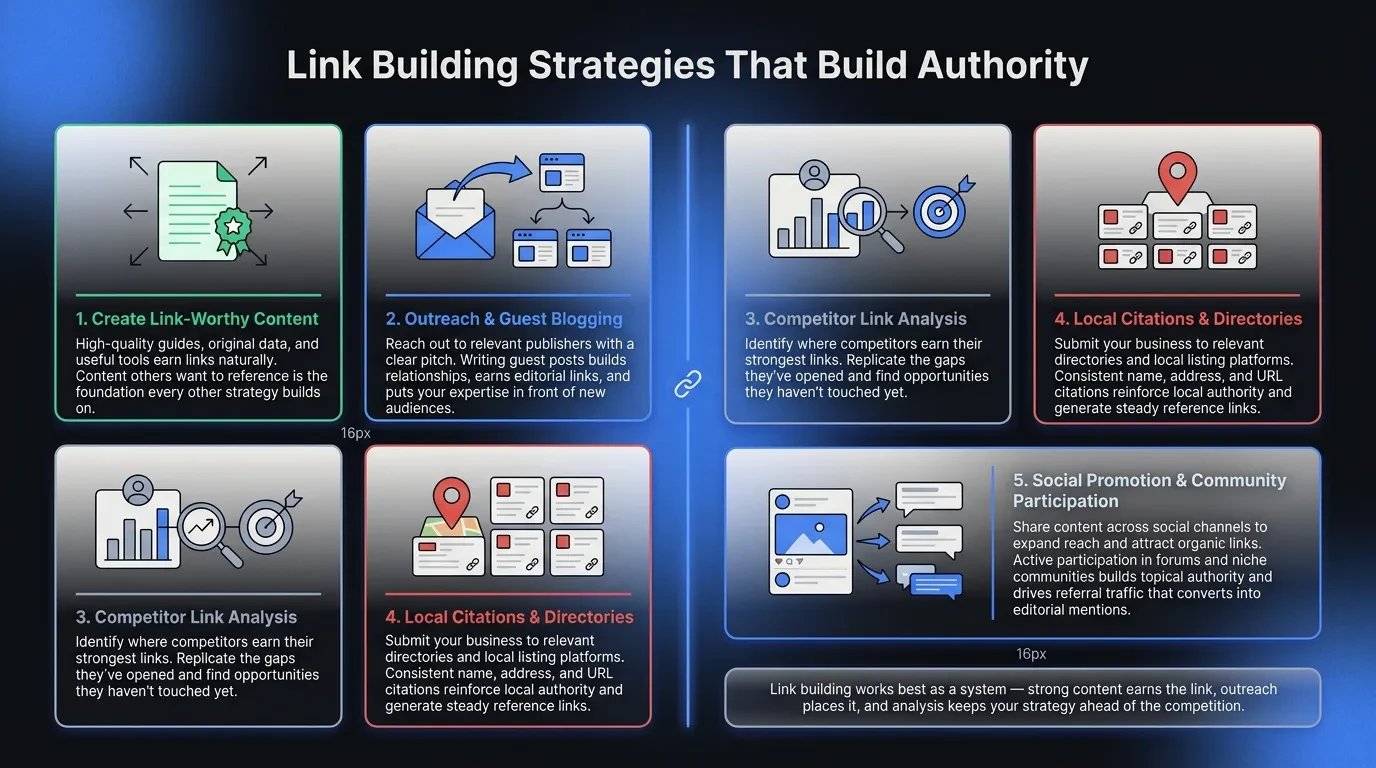
Now the fear most owners have when someone suggests "city pages": will Google penalize me for them? It can. Google's spam policies explicitly name doorway pages — batches of near-identical pages targeting specific cities that all funnel visitors to the same place.
The line between a doorway page and a genuinely useful service area page is real experience. A page that earns its ranking answers one question convincingly: does this business actually work here? That means jobs you've completed in that area with specifics, problems particular to that area — hard water in one suburb, aging wiring in another, parking restrictions downtown — plus reviews from customers there and photos taken on those streets.
What gets businesses suppressed is the opposite: fifty pages with the same 300 words and a swapped city name. Google's systems detect near-duplicate pages, pick one representative, and quietly demote the rest. You spend weeks building pages that end up invisible.
If you can't write 400 unique words about an area from real experience, you're not ready to build that page. Start with three to five pages for the areas that bring you the most revenue, make each one undeniably local, and add more as your job history grows. Three strong pages outperform fifty thin ones — and they keep your site on the right side of Google's policies while doing it.
Reviews Are Your Strongest Weapon Against Proximity
Review signals carry around 16% of map pack ranking weight in Whitespark's 2026 report — but for a service area business they punch above that number, because prominence is the lever you fully control. What matters most isn't your lifetime total. It's velocity (new reviews arriving consistently), recency, and whether you respond.
So build a system instead of hoping. Ask at the moment the job ends — in person or by text with a direct review link — because a customer standing next to their fixed boiler says yes far more often than one emailed three days later. Then respond to every review, positive or negative, within a few days.
There's a bonus most owners miss: customers name their location in reviews naturally. "Came out to our place in Didsbury the same day" is a location signal Google trusts precisely because you didn't write it. Thirty reviews spread across your service areas quietly do what no amount of profile editing can.
Two rules keep you safe. Never pay for or incentivize reviews — that violates Google's policies and is another suspension trigger. And never gate them by only asking happy customers through a filter tool; Google has called that practice out directly.
One more reason reviews compound: AI assistants now answer "find me a cleaner near me" queries by reading these same signals, with review recency and sentiment high on the list. If you want your business surfacing in AI-driven search too, our Answer Engine Optimization guide covers that next layer.
Your First 30 Days, in Order
This probably sounds like a lot for someone who's on jobs all day. It isn't — almost everything above is a one-time setup plus a weekly habit, and none of it requires paid tools. Here's the order that gets results fastest.
Week 1: Set up or fix your Google Business Profile. Hide the address, set up to 20 realistic service areas, nail the primary category, list every service, upload ten real photos.
Week 2: Build your review engine. Write your ask-by-text message, save the direct review link, and send it to your last ten happy customers. Respond to every review you already have.
Week 3: Write your first service area page for your highest-revenue area. Real jobs, real problems, real photos — 400+ unique words.
Week 4: Write the second page, then check that your business name, phone number, and service areas match exactly everywhere you're listed online. Inconsistent details erode Google's trust in your business data.
After that, the maintenance is light: ask for reviews after every job, add photos monthly, and build one new area page a month as your job history justifies it. Most service area businesses see movement in the map pack within two to three months of consistent signals — slower than ads, but unlike ads, it doesn't stop when you stop paying.
Your Website Carries Half of This Work — Make Sure It Can
Everything above gets you found; your website gets you chosen. When someone taps through from the map pack to a slow, generic site with no mention of their area and a buried phone number, the lead dies there — and the weak page drags your relevance signals down with it.
A service business site that pulls its weight has fast-loading service pages, area pages built the way this guide describes, visible contact details on every screen, and reviews woven through it. That's the half of local SEO that Google Business Profile can't do for you — and it's exactly what we build in our websites for service businesses.
If your current site can't support the pages this playbook calls for, book a chat with Vediwood and we'll map out what it needs.
Follow Us
Most founders read us once and change something that week.
Every issue covers one thing that makes your website work harder — better conversion, stronger SEO, or smarter design. No fluff, no agency speak. Just the decision you need to make this week.
Our Team

Sadiki Said
Full Stack Developer

Nezha Essyed
Content Strategist