Answer Engine Optimization (AEO): The Complete 2026 Guide to Getting Your Brand Cited by AI
AEO is the new SEO. Learn what Answer Engine Optimization is, why it matters in 2026, and how to structure your content so ChatGPT, Perplexity, and Google AI Overviews cite your brand.
The search bar is no longer the only entrance to your brand.
ChatGPT now has 883 million active users. Google AI Overviews appear in 55% of all searches. Perplexity, Gemini, and Microsoft Copilot are answering millions of questions every day — and when they do, they cite sources. They pull from somewhere. The brands that built the right kind of content are getting named. The ones that didn't are invisible.
That's the world Answer Engine Optimization was built for.
AEO isn't a trend. It's a structural shift in how discovery works — and in 2026, it's the most important content strategy decision you'll make.
This guide covers everything: what AEO is, how it works, what separates cited brands from overlooked ones, and exactly what to do about it.
What Is Answer Engine Optimization (AEO)?
Answer Engine Optimization (AEO) is the practice of structuring your content so that AI-powered answer engines — ChatGPT, Perplexity, Google AI Overviews, Gemini, and Microsoft Copilot — extract it, trust it, and cite it directly in their generated responses.
Traditional SEO was about ranking. AEO is about being the answer.
When someone asks an AI "What's the best video production approach for a product launch?" or "How do I optimise my content for AI search?" — the model doesn't return ten blue links. It generates a response. And that response is built from content it deems authoritative, structured, and trustworthy.
AEO is the discipline of becoming that source.
The term captures a new layer of search behaviour — one where the user never leaves the chat interface, and visibility means being quoted, not clicked.
Why AEO Matters More Than Ever in 2026
The numbers aren't subtle.
- AI search visits grew 42.8% year-over-year — from 15.6 billion to 27.4 billion between Q1 2025 and Q1 2026
- Google AI Overviews now cover 55% of all searches — the majority of search results have an AI-generated layer on top
- ChatGPT hit 883 million monthly active users — larger than most social media platforms
- Gartner predicts 25% of organic search traffic will shift to AI chatbots by 2026 — that's a quarter of your current discovery channel
- AEO-optimised content shows 9x higher conversion rates vs traditional SEO content for the same keywords
The brands ignoring this aren't just leaving traffic on the table. They're ceding narrative control. When an AI answers a question about your industry and doesn't mention you, that's a trust gap your competitors are filling.
AEO isn't about chasing AI. It's about being present where your audience is already asking questions.
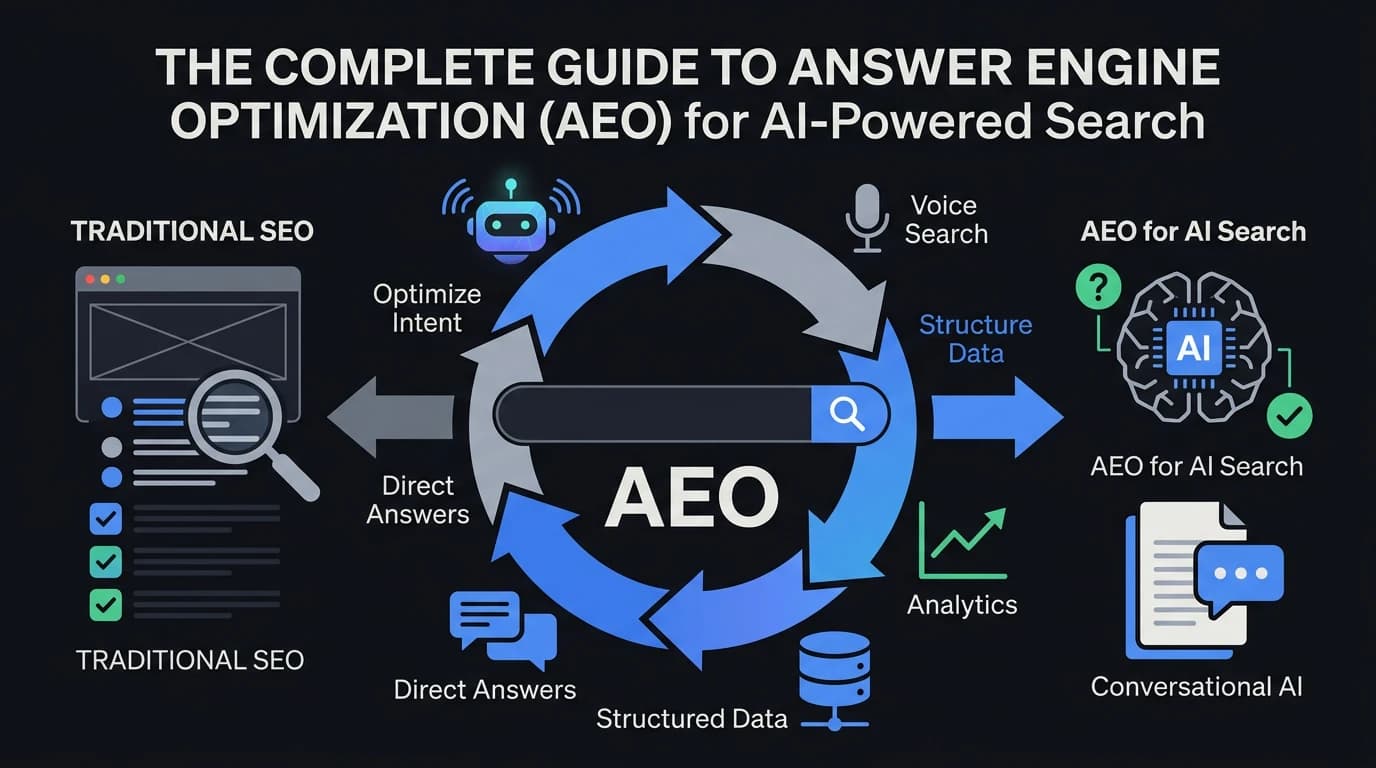
AEO vs SEO: What's the Difference?
The simplest version: SEO gets you ranked. AEO gets you cited.
Goal — SEO: Rank on search results pages. AEO: Be cited in AI-generated answers.
Format — SEO: Long-form pages, deep keyword coverage. AEO: Short answer blocks, FAQ format, structured data.
Success metric — SEO: Rankings, click-through rate, traffic. AEO: AI citations, featured snippet appearances, brand mentions.
Primary audience — SEO: Google's crawlers → human clickers. AEO: LLM retrieval systems → human readers.
Content style — SEO: Comprehensive, keyword-rich. AEO: Answer-first, extractable, authoritative.
The critical point: 99% of URLs that appear in Google AI Mode also rank in the top 20 organic search results. Foundational SEO strength is a prerequisite for AEO visibility. AEO builds on top of SEO — it doesn't replace it.
Build your SEO foundation. Then layer AEO on top.
How Answer Engines Decide What to Cite
To win at AEO, you need to understand what these systems are actually doing.
AI answer engines — whether Google AI Overviews, Perplexity, or ChatGPT's browsing mode — operate on a core principle: find the most trustworthy, clearly structured answer to the user's question, and synthesise it into a response.
They're looking for three things:
- Clarity of answer. Can the system extract a direct, clean answer from your content? If your answer is buried in three paragraphs of preamble, it gets skipped.
- Entity authority. Does your site, brand, and author have a clear, verifiable identity? AI systems use entity signals — who you are, what you're known for, who links to you — to calibrate how much to trust your content.
- Structural signals. Is your content marked up in ways that make it machine-readable? Schema markup, FAQ structure, and clean HTML hierarchy all reduce the cognitive load on AI retrieval systems.
The brands that get cited are the ones that made it easy.
The 5 Core Pillars of AEO
1. Answer-First Content Structure
Every piece of AEO-optimised content should open with a direct, 40–60 word answer to the primary question. Not a preamble. Not a thesis statement. The answer.
LLMs scan for this. They find it, extract it, and cite the source. If you make them hunt for your point, they'll find someone else's instead.
Apply this at every level:
- Page introductions — answer the core question before you explain it
- H2 sections — treat each section as a self-contained answer to a sub-question
- FAQ blocks — add FAQ sections to every content page, structured as actual questions your audience asks
2. Schema Markup & Structured Data
Schema markup is the language AI systems use to understand what your content is about before they read it.
The most valuable schema types for AEO in 2026:
- FAQPage schema — maps question-answer pairs directly to how AI retrieval works
- Article/BlogPosting schema — signals content type, author, publish date, freshness
- Organization schema — establishes your entity identity (name, URL, logo, sameAs links)
- Person schema — author credibility and expertise signals
- HowTo schema — for process-driven content
The 2026 standard is "Schema Stacking": nesting multiple schema types within a single JSON-LD @graph structure to give AI systems a complete 360-degree view of your brand in one pass.
The fields most teams skip — but that actually drive citation outcomes — are: sameAs, knowsAbout, dateModified, and mainEntityOfPage.
3. Entity Authority & Brand Signals
AI systems calibrate trust using entity signals. Your brand is an entity. The clearer and more consistent that entity is across the web, the more AI systems trust it as a source.
Building entity authority means:
- Consistent NAP data — name, address, phone number consistent across every directory and platform
- Wikipedia/Wikidata presence (where applicable) — AI systems heavily weight Wikimedia citations
- Author bios with credentials — AI systems evaluate author expertise as a trust signal
- Backlinks from authoritative domains — link authority still matters for AEO; it feeds entity trust
- Social proof and press mentions — AI models treat brand mentions in reputable publications as entity validation
For emerging brands, the fastest path to entity authority is publishing consistently on one or two primary platforms, building inbound links from niche-authoritative sources, and ensuring your sameAs schema links to active, verified profiles.
4. Site Trust & Technical Foundation
AEO has prerequisites. A site that's slow, poorly structured, or blocks AI crawlers is invisible by default.
The non-negotiables:
- Allow AI crawlers — check your robots.txt for blocks on GPTBot, PerplexityBot, Googlebot
- Core Web Vitals — fast load times and stable layouts are baseline for AI crawl prioritisation
- HTTPS — mandatory
- Clean URL structures — descriptive, keyword-relevant slugs
- Mobile-first — AI crawlers prioritise mobile-rendered versions
5. Consistent Publishing Cadence
Freshness is a trust signal. AI systems calibrate content relevance partly on dateModified and publication frequency. A site that published once in 2023 and went quiet is a deprioritised source.
Publishing consistently — even at one high-quality piece per week — signals that your entity is active, current, and worth citing.
More importantly: every new piece of content is a new citation opportunity. The more high-quality, answer-structured content you publish, the more surface area you create for AI systems to find and reference your brand.
How to Write Content That Gets Cited by AI
The format shift required for AEO is real but achievable. Here's the practical framework:
The AEO Content Formula:
- Headline — include the primary keyword naturally; make it a direct question where possible
- Definition block — first 60 words define the term or answer the core question
- Why it matters — 2–3 sentences establishing stakes and relevance
- Numbered or structured breakdown — AI systems love lists; they're extractable
- FAQ section — 5–8 questions your audience actually asks, with clean 40–60 word answers
- Authoritative data — cite stats with sources; AI systems prioritise content that references verifiable data
- CTA — what the reader should do next
Language rules for AEO:
- Use the exact question phrasing your audience uses ("What is AEO?" not "Exploring the concept of answer engine optimisation")
- Write at an 8th-grade reading level — clarity over sophistication
- Use active voice: "AI engines cite this" not "this is cited by AI engines"
- Avoid jargon without definition
AEO for Creative & Video-First Brands
Here's something most AEO guides don't address: video content is an underutilised AEO asset.
AI systems can't watch video directly — but they can read transcripts, descriptions, structured metadata, and any text content surrounding that video. A video production brand that publishes work without written context is leaving massive AEO value unrealised.
How video-first brands can win at AEO:
- Publish transcripts of every video — AI systems can index and cite these directly
- Write answer-structured descriptions for every YouTube video — your YouTube descriptions rank in Perplexity
- Create companion articles for video projects — a case study article answering "how did Vediwood achieve this result" is AEO gold
- Use VideoObject schema — marks up your video content for AI retrieval
- Build FAQ content around your production process — "How much does a brand video cost?" "What's the production timeline for a commercial?" — these are real AEO opportunities
The bigger picture: Creative brands build authority differently. Your portfolio, your client outcomes, your process, your expertise — these are your entity signals. Documented properly, they become the foundation of an AEO strategy no generic agency can replicate.
Your work is the proof. AEO is the amplifier.
Measuring AEO Success
AEO requires a different measurement mindset than traditional SEO. You're not just measuring traffic — you're measuring presence.
AI citation rate — Manual queries on ChatGPT, Perplexity, Gemini; tools like Profound, Otterly.
Featured snippet ownership — Google Search Console + manual SERP checks.
Brand mention volume — Brand monitoring tools (Mention, Brand24).
Direct traffic uplift — GA4 — indicator of brand awareness built through AEO.
Zero-click visibility — Impression data in GSC without corresponding clicks.
Set a baseline now. Query your core keywords across ChatGPT, Perplexity, and Google AI Mode. Note whether your brand, your content, or your competitors' content appears. That's your starting point.
Run the same queries every 30 days. Citation rates build gradually — like domain authority, but for AI visibility.
Your AEO Action Plan for 2026
You don't need to rebuild your entire content strategy. You need to layer AEO on what you already have.
30-Day Starter Plan:
Week 1 — Audit
- Crawl your top 10 pages; identify which have answer-first structure and which don't
- Check robots.txt for AI crawler blocks
- Run your 5 core keywords through ChatGPT, Perplexity, and Google AI Mode — document what you find
Week 2 — Quick Wins
- Add a FAQ section to your top 5 content pages
- Implement FAQPage + Article schema on those same pages
- Update author bios with expertise signals and sameAs links
Week 3 — Reformat
- Rewrite page introductions to lead with the answer (40–60 words)
- Add dateModified to all schema
- Submit updated sitemap to Google
Week 4 — Build
- Publish 2 new AEO-optimised articles targeting high-intent questions in your niche
- Add VideoObject schema to any video content you've published
- Set up brand monitoring to track citation growth
Ongoing:
- Publish consistently (minimum 1 piece per week)
- Update existing content quarterly with fresh data
- Track AI citation rates monthly
The Bottom Line
AEO is not the future of search. It's the present.
883 million people are asking AI questions right now. 55% of Google searches have an AI layer on top. The brands being cited are building trust, authority, and demand — without buying a single ad.
The brands being skipped are watching their traffic plateau and wondering why.
You don't need to choose between SEO and AEO. You need to build content that's strong enough to win in both environments — foundational enough to rank, and structured enough to be cited.
That's the new standard. And the window to get ahead is still open — but it's narrowing.
Ready to build an AEO-ready content system for your brand? Talk to Vediwood →
FAQ: Answer Engine Optimization
What is the difference between AEO and SEO?
SEO optimises content to rank on search engine results pages. AEO optimises content to be cited directly by AI answer engines like ChatGPT, Perplexity, and Google AI Overviews. Both are necessary in 2026 — SEO builds the foundation, AEO captures the AI layer on top.
What is AEO in marketing?
In marketing, AEO (Answer Engine Optimization) is the practice of structuring brand content so that AI-powered answer systems select and cite it when answering user queries. It's how brands maintain visibility in an environment where users ask questions and receive direct answers instead of clicking links.
How do I optimise for answer engines?
Start with answer-first content structure (lead with a 40–60 word answer), implement FAQPage and Article schema markup, build entity authority through consistent brand signals, and publish fresh, authoritative content regularly. Allow AI crawlers in your robots.txt and track citation rates monthly.
Does AEO replace SEO?
No. AEO builds on top of SEO. 99% of AI-cited URLs also rank in the top 20 organic search results — meaning foundational SEO strength is a prerequisite for AEO visibility. The strongest 2026 strategy performs in both environments.
What tools can I use to measure AEO?
Tools like Profound.ai, Otterly, and AirOps track AI citation rates across platforms. Combine these with Google Search Console for featured snippet data, Brand24 or Mention for brand monitoring, and manual querying across ChatGPT, Perplexity, Gemini, and Google AI Mode.
What is Answer Engine Optimization for video brands?
For video brands, AEO means publishing transcripts, companion articles, and structured descriptions alongside video content so AI systems can index and cite the expertise behind the work. VideoObject schema, YouTube description optimisation, and FAQ content about your production process are the key levers.
Follow Us
Most founders read us once and change something that week.
Every issue covers one thing that makes your website work harder — better conversion, stronger SEO, or smarter design. No fluff, no agency speak. Just the decision you need to make this week.
Our Team
Sadiki Said
Full Stack Developer

Nezha Essyed
Content Strategist