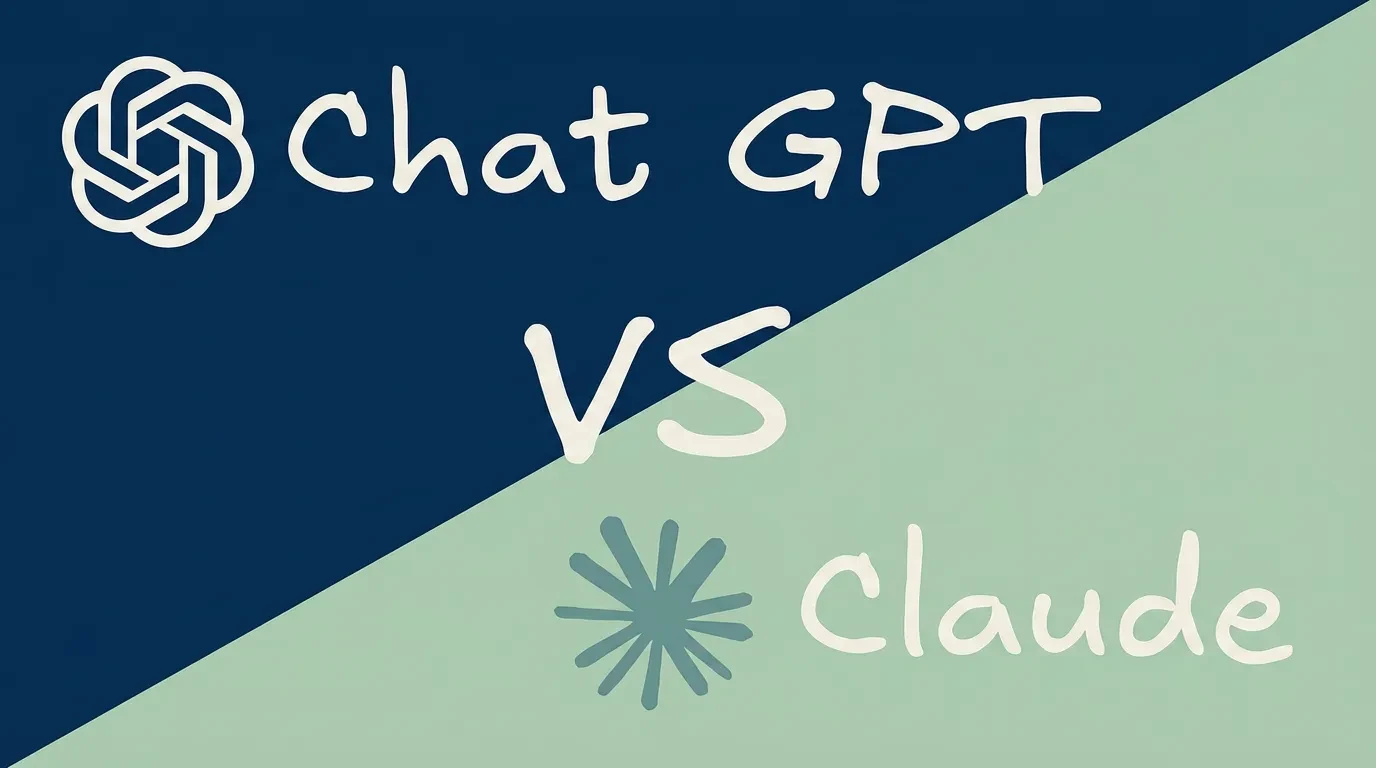
ChatGPT and Claude both cost $20 per month. The expensive mistake is not the subscription — it is picking the one that does not match the work you actually do every day.
Both tools improved dramatically in 2026. Both handle general questions well enough that you would struggle to tell them apart on routine prompts. But they are built for different kinds of work, and the business owner who picks based on a feature checklist instead of daily tasks will underuse what they paid for — or stop using AI entirely because it "didn't click."
This guide compares ChatGPT vs Claude for business by the tasks that actually matter — writing, analysis, document review, marketing, and operations — so you can make the right call without trialling both for three months first.
The Short Answer — Claude for Depth, ChatGPT for Breadth
If you need one sentence: Claude is the better tool when precision, long documents, and writing quality matter most, and ChatGPT is the better tool when you need broad functionality, visual content, and a wide range of integrations.
Claude's strength is focus. It follows complex instructions more faithfully, holds more text in memory during a single conversation, and produces writing that needs less editing. Contract review, proposal drafting, financial analysis, client-facing reports — any task where getting it right the first attempt saves hours of rework is where Claude consistently outperforms.
ChatGPT's strength is range. It generates images with DALL-E, handles voice conversations, connects to hundreds of third-party tools through its plugin ecosystem, and runs browser-based agents that complete tasks across the web without switching apps. If your work spans many different types of output — text, visuals, research, automation — ChatGPT covers more ground in a single subscription.
Neither tool is universally better. A consulting firm that writes proposals and analyses contracts will get more from Claude. An e-commerce brand that needs product images, social captions, and marketing copy at scale will get more from ChatGPT. The worst decision is the one made by default — someone on your team tried one, liked it enough, and now the whole company uses it without ever testing whether the other tool fits the actual work better.
For general-purpose prompts — brainstorming, answering questions, summarising meetings — the gap between them has narrowed to the point where personal preference matters more than performance benchmarks. Pick the one that matches your heaviest daily workload, not the one that won a leaderboard that changed two weeks later.
Where Writing Quality Actually Differs
This is where most business owners notice the difference first. Claude produces writing that sounds less like AI. Its default tone is measured, specific, and closer to how a competent human would phrase things. ChatGPT tends toward enthusiasm — more adjectives, more bullet points, more "here's what you need to know" energy that reads fine in a first draft but requires editing before you send it to a client.
Claude is the stronger choice when voice and nuance matter. Proposals, reports, long-form articles, client-facing emails — anything where the reader will judge your credibility based on how the writing reads. Claude follows style guides more reliably and handles tone shifts within a single document — formal introduction, conversational body, direct close — without losing coherence halfway through.
ChatGPT is faster when volume matters more than polish. Fifty product descriptions before the end of the week. A batch of FAQ answers for a new product launch. Social media captions that need to be on-brand but do not need to sound like they were individually crafted. ChatGPT handles templated, repeatable content more efficiently because it does not pause to question your approach — it executes.
One practical test: give both tools the same prompt — "write a 200-word email to a client explaining a project delay" — and read the outputs aloud. Claude's version will typically sound like something you would actually send. ChatGPT's will sound like something you would rewrite before sending. That rewriting time is invisible in the subscription price, but it compounds across a team sending dozens of client communications each week.
For marketing copy specifically, the answer depends on format. ChatGPT produces punchier short-form social content out of the box. Claude produces better landing page copy, case studies, and anything longer than 300 words where the reader needs to trust the author's understanding. If your business publishes regularly, Claude reduces the editing burden. If your business runs on high-volume short-form content, ChatGPT gets the first drafts out faster.
OpenAI's latest GPT-5.5 model is noticeably better at natural-sounding prose than its predecessors. The writing gap is narrowing with every update. But as of mid-2026, Claude still sets the standard for business writing that reads like it was written by someone who understands the subject — not by a model that learned about it from training data.
Why the Context Window Matters More Than the Model Name
The context window determines how much text an AI tool can hold in memory during a single conversation. Think of it as working memory — everything the tool can see and reason about at once.
Claude holds 200,000 tokens on its standard $20 paid plan — roughly 150,000 words, or the length of a full business book. ChatGPT Plus holds 128,000 tokens on the standard paid tier. Both tools support up to 1 million tokens at the API level, but for the chat interface that most business owners use directly, Claude gives you roughly 50% more room.
Why does this matter? Because real business documents are long. An employee handbook runs 50 to 80 pages. A set of vendor contracts for a procurement review might hit 200 pages. A transcript from a 90-minute client strategy call is 15,000 to 20,000 words.
If you need the AI to work with your actual documents — not summaries of them — the context window determines whether you can do the job in one pass or have to break it into pieces and lose coherence at the boundaries. When you chunk a 60-page contract into four parts and ask the tool to review each one separately, it cannot catch contradictions between section 12 and section 47. Claude can hold the entire document and reason across it.
In practical business terms, the context window difference shows up most in three scenarios: reviewing contracts against standard terms, analysing a full quarter of customer feedback data in one conversation, and uploading long meeting transcripts for action item extraction. For any of these, Claude's larger window means fewer workarounds and more reliable output.
If your business rarely works with documents longer than 20 pages, this difference will not affect you. If long-document work is a regular part of your operations, context window size is the single most important feature in the comparison.
Five Business Tasks That Show Which Tool You Need
Feature lists are abstract. Tasks are concrete. Here is how each tool handles the work that business owners actually do every day.
Drafting Client Proposals
Claude. A proposal needs to follow your tone, reference specific details from previous conversations, and read like it was written by someone who understood the project brief. Claude holds the full context, follows formatting instructions precisely, and produces prose that needs minimal editing before it reaches the client. The time saved on rewriting alone justifies the subscription for any service business that sends more than a few proposals per month.
Creating Social Media Content at Scale
ChatGPT. When you need 20 Instagram captions, a week of LinkedIn posts, three email subject line variants, and a set of ad headlines by Friday, ChatGPT's speed and built-in image generation make it the more productive choice. Generate on-brand visuals with DALL-E without switching to Midjourney or Canva. For volume content workflows, ChatGPT is faster from prompt to published.
Reviewing Contracts and Policies
Claude. Upload a 60-page contract and ask Claude to flag non-standard clauses, compare it against your template, or summarise the key obligations by party. The larger context window and stronger instruction-following mean fewer missed details and more structured, reliable analysis. One professional services firm reported saving 8 hours per week on contract review after switching their workflow to Claude.
Analysing Customer Feedback
Claude. Export your NPS responses, support tickets, or product reviews, upload the full dataset, and ask for patterns. Claude handles large text datasets more consistently and produces structured analysis — categorised themes, sentiment breakdowns, quoted examples — with less back-and-forth prompting than ChatGPT requires for the same depth of output.
Building Marketing Visuals and Branded Assets
ChatGPT. Claude does not generate images. If your marketing workflow requires product mockups, social graphics, blog post headers, or ad creative, ChatGPT's DALL-E integration handles it within the same conversation where you wrote the copy. For businesses that produce visual content regularly, this eliminates the need for a separate image generation subscription.
The pattern is clear. Claude wins when the task requires precision, long context, and polished writing. ChatGPT wins when the task requires speed, visual output, or broad integrations. Most businesses have both types of tasks — which is why many owners paying $40 per month for both tools report that the combined cost pays for itself in the first week.
What $20 Per Month Actually Gets You in Each Tool
The subscription price is identical. What you receive for it is not.
ChatGPT Plus ($20/month) includes:
- Access to GPT-5 series models including GPT-5.5
- DALL-E image generation
- Advanced Voice Mode for real-time voice conversations
- Web search and deep research
- Custom GPTs and access to the GPT marketplace
- Canvas for in-app document editing
- Codex for agentic coding tasks
Claude Pro ($20/month) includes:
- Access to Claude Sonnet 4.6, Opus 4.8, and Fable 5
- 200,000-token context window
- Claude Code for agentic coding
- Projects for organising related conversations and files
- Web search and deep research
- Writing Styles for switching between custom tones
ChatGPT bundles more types of output — text, images, voice, web agents. Claude bundles more depth on the tasks it covers — longer context, more precise coding, better writing fidelity.
At the API level, where automated workflows run, ChatGPT is cheaper per token. GPT-4o costs $2.50 per million input tokens and $10 per million output tokens. Claude Sonnet 4.6 costs $3 per million input and $15 per million output. For high-volume automated processing, that difference compounds over thousands of calls.
But raw token cost is one variable. If Claude's stronger instruction-following means fewer retries and less post-processing to get a usable result, the effective cost per output can be comparable. Measure on your actual workload, not on the rate card alone.
Both offer premium tiers at $100 to $200 per month for power users who hit the standard plan's usage limits. ChatGPT also has an $8/month Go plan with ads — useful for team members who need occasional access without the full subscription.
What Happens to Your Business Data Inside Each Tool
Before your team starts pasting client information into a chatbot, check what happens to that data.
Both tools offer enterprise-grade compliance on their business plans. Both are SOC 2 compliant. Both support HIPAA eligibility for healthcare use cases. Both provide data residency options and admin controls on team and enterprise tiers.
The differences are in the defaults.
Claude is more conservative by design. Anthropic built Claude using Constitutional AI — a framework that makes the model's safety behaviour auditable and predictable. In practice, this means Claude is less likely to generate confident-sounding hallucinations on legal and financial topics, and it defaults to caution when a prompt is ambiguous. For businesses in regulated industries — finance, healthcare, legal — this conservatism reduces the risk of AI-generated content creating liability.
Claude has achieved FedRAMP High authorisation through AWS GovCloud — the highest federal security certification available. ChatGPT's FedRAMP process is still in progress as of mid-2026.
ChatGPT's data handling is solid but more permissive by default. OpenAI's business and enterprise plans include options to opt out of data training. However, the free and Plus consumer tiers may use your conversations to improve future models unless you actively disable this in the settings. Check the data controls before your team begins uploading client contracts or financial documents.
For small businesses: the paid tiers of both tools meet most standard compliance requirements. The practical step is to review each tool's data usage policy, disable training on your inputs where that option exists, and set clear guidelines for what your team should and should not enter into any AI tool — regardless of which one you choose.
ChatGPT vs Claude for Business: How to Choose Based on What You Do
Stop comparing feature lists. Start with what your business does every day.
Service Businesses — Consulting, Coaching, Agencies
Start with Claude. Your work is proposals, strategy documents, reports, and client communication where tone and precision matter. Claude's writing quality, larger context window, and stronger instruction-following save time on every document that leaves your desk. The ability to upload an entire project brief and get a coherent first draft — not a summary — is worth the subscription on its own.
Product Businesses — E-Commerce, DTC, Retail
Start with ChatGPT. Your work involves product descriptions at scale, marketing visuals, social content, and customer-facing copy that needs to move fast. ChatGPT's image generation, broader integration ecosystem, and faster templated output fit the high-volume workflow better. The GPT marketplace also offers pre-built assistants for common e-commerce tasks.
Content Businesses — Media, Publishing, Education
Use both. Claude for the writing — articles, courses, scripts, newsletters where voice matters. ChatGPT for the visual layer — cover images, social graphics, promotional assets, and multimedia content. The $40 per month combined cost is less than one hour of freelance writing, and each tool handles the work the other cannot.
Solo Founders and Small Teams
Pick the one that matches your heaviest workload. If you write more than you design, start with Claude. If you create more visual content than written content, start with ChatGPT. Use the free tier of the other tool for two weeks before deciding whether the second subscription is worth it.
Three Questions to Make the Call
- What is your most time-consuming daily task? Writing, analysis, or document work points to Claude. Visual content, broad productivity, or integration-heavy workflows point to ChatGPT.
- Does your industry have compliance requirements? If yes, evaluate Claude's conservative defaults and FedRAMP authorisation first. If compliance is not a concern, choose on task fit alone.
- How will your team actually use it? A tool that nobody adopts is worse than a suboptimal tool that everyone uses. If your team already knows ChatGPT, the switching cost to Claude must be justified by measurable time savings on specific tasks — not by a benchmark score.
What Changes by the End of 2026 — and What Does Not
Both Anthropic and OpenAI ship model updates every few months. By the time you read a benchmark comparison, a newer version has probably already been released. The raw capability gap between the two tools will continue to narrow. The differences in focus — Claude's depth versus ChatGPT's breadth — are strategic choices by each company that will persist even as both improve.
What is likely to change:
- Pricing will compress further as competition from Google's Gemini and open-source models intensifies
- Both tools will gain stronger agentic features that handle multi-step tasks with less human oversight
- Claude will expand its integration ecosystem and ChatGPT will continue improving its writing quality
- New flagship models from both providers will ship before the year ends
What is unlikely to change:
- Claude's advantage on long-context precision work and instruction fidelity
- ChatGPT's advantage on multimodal output and ecosystem breadth
- The $20/month consumer price point — it has become the industry standard
- The core design philosophy — Claude as the focused, careful tool and ChatGPT as the versatile, expansive one
The best decision is based on today's work, not on features that might ship next quarter. If your needs change, switching tools is straightforward — neither requires a contract, and your workflows are transferable. The real risk is not picking the wrong tool. The real risk is spending three months evaluating both and using neither.
If You Are Still Deciding, Start Here
The comparison above gives you the framework. The decision depends on what your business actually does every day — not on what a feature list says should matter.
If you are evaluating AI tools as part of a broader question about your digital strategy — how your website converts visitors, how your content performs in search, how your technical decisions support business growth — that is the work we do at Vediwood.
We build websites and digital strategies for businesses that take their online presence seriously. AI tools are one piece of that picture. The right chatbot subscription only matters if the rest of the system — your site, your content, your visibility — is already working for you.
See how Vediwood approaches digital strategy — and whether it makes sense to talk about yours.
Follow Us
Most founders read us once and change something that week.
Every issue covers one thing that makes your website work harder — better conversion, stronger SEO, or smarter design. No fluff, no agency speak. Just the decision you need to make this week.
Our Team

Sadiki Said
Full Stack Developer

Nezha Essyed
Content Strategist