Topical Authority SEO: How to Become the Go-To Source
Publishing more posts won't move your rankings if Google can't tell what your site is actually about. Here's how topical authority works in 2026 and the exact pillar-and-cluster plan to become the source Google trusts.

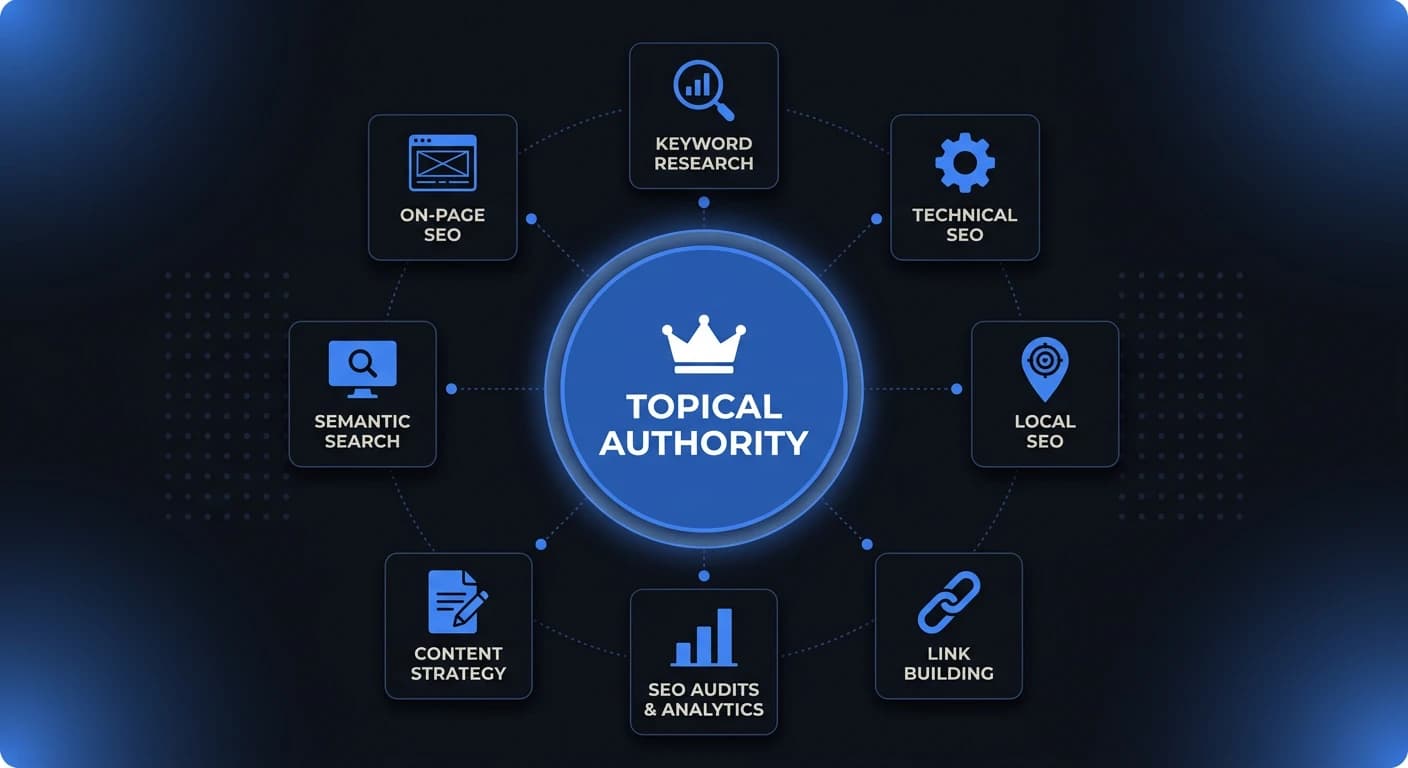
You keep publishing, and your rankings barely move. The problem is rarely your writing — it's that Google can't tell what your site is the expert on. Topical authority SEO is how you fix that: you cover one subject so completely that search engines treat your site as the go-to source, not just another page that happened to match a keyword. Google now ranks sites it trusts on a topic, not isolated pages. This guide shows you what topical authority is, why it became the dominant ranking signal in 2026, and the exact plan to build it.
What Topical Authority Actually Means (and Why One Page Won't Cut It)
Topical authority is search engines recognising your site as the expert on a subject — across every related question, not one keyword. You earn it by covering a topic in depth and connecting that content so Google can see how it all fits together. The more complete your coverage, the more queries you rank for, including ones you never directly wrote about.
It is not the same as domain authority. Domain authority is a third-party score based mostly on backlinks, and it measures your whole site's strength. Topical authority is niche-specific — a small site can own a subject that a much bigger brand only touches.
Picture two sites selling running shoes. One has twelve deep articles on running injuries, gait, and shoe fit. The other has two hundred scattered posts on everything from shoes to crypto to recipes.
Google trusts the focused site on running, even though it published far less. The signal is clarity, not volume. Depth on one subject beats breadth across many — and that single idea drives everything else in this guide.
Why Topical Authority Became the #1 Ranking Signal in 2026
Google's ranking systems have moved in one direction for over a decade: rewarding sites that genuinely understand a subject. The 2026 core update pushed this further, making topic-level expertise the clearest quality signal a site can send. If you have published for months and seen nothing, this shift is usually why.
The framework behind it is E-E-A-T — Experience, Expertise, Authoritativeness, and Trustworthiness. Google evaluates these relative to a topic, not site-wide, which is why a site can look credible on finance and stay invisible on health. You can read Google's own explanation in its guidance on creating helpful, people-first content.
Google's 2024 internal documentation leak surfaced two signals worth knowing. One measures how concentrated your content is around a core subject. The other measures how far your content strays from that center.
The takeaway is blunt: publishing off-topic content can actively weaken your authority, not just fail to help it. Google's broader ranking systems guidance points the same way — depth and relevance win.
AI search raised the stakes again. Tools like ChatGPT, Perplexity, and Google's AI answers break one question into several smaller ones, then cite the sites that cover all of them. Broad, shallow content gets skipped entirely. Comprehensive coverage is now the price of being cited at all.
The Pillar-and-Cluster Model: How Authority Gets Built
Topical authority has a structure, and it is simpler than it sounds. You build one broad pillar page on your main topic, then a set of cluster pages that each go deep on a single sub-question. Every cluster links back to the pillar, and the pillar links out to every cluster.
The pillar is the overview — the page someone reads to understand the whole topic at a high level. The clusters are the specifics: the how-tos, the comparisons, the edge cases that answer one precise question each. Together they tell Google you have covered the subject from every angle.
Say you run a studio that builds online stores. Your pillar might be "e-commerce website design." Your clusters would be checkout UX, product page layout, page speed, payment options, and mobile design. Each one answers a real question a store owner types into Google.
The links between them are not decoration. Internal links are how Google connects your pages into a single body of expertise. Without them, you have a pile of unrelated articles. With them, you have a topic you own — which is exactly the structure we use when we plan a client's content from the start.
How to Build Topical Authority: A 5-Step Plan
Building topical authority is a process, not a single post. Here is the plan we follow, step by step.
1. Pick one topic you can credibly own
Start narrow. Choose a subject your business has real experience in, with enough search demand to be worth the effort. "Coffee" is too broad to own; "home espresso" is specific enough to dominate. The tighter your focus, the faster Google builds a clear picture of what you do.
2. Map every question your audience asks
List every sub-question inside your topic — that map becomes your content plan. Use Google autocomplete, the "People also ask" box, and the related searches at the bottom of the results page. Each distinct question is a potential cluster page, and the wording people use is the wording you should write for.
3. Write the pillar first, then the clusters
Publish the pillar page that covers the whole topic at a high level. Then write each cluster page to fully answer one sub-question, and match the format to the search — a how-to for "how to," a comparison for "X vs Y." Depth wins here: one thorough page beats three thin ones every time.
4. Link the cluster together
Connect every cluster page back to the pillar, and link related clusters to each other where it makes sense. Use descriptive anchor text that names the topic — never "click here" or "read more." This is the step most sites skip, and it is the one that makes a set of pages read as genuine authority.
5. Earn relevant links and keep it fresh
Pursue backlinks from sites in your niche — one link from a relevant site outweighs ten from unrelated ones. Then revisit your cluster every few months: update old stats, refresh examples, and add new questions before a competitor answers them first. Topical authority is built once and maintained forever.
How Many Articles You Need — and How Long It Takes
The honest answer is that it depends on your niche, but the ranges are knowable. A tight, specialised topic can reach authority with fifteen to twenty well-connected pages. A broad subject might need fifty or more.
The number matters far less than the coverage. Topical authority comes from covering a topic completely, not from sheer page count. Twenty focused pages that answer every real question will beat a hundred that repeat each other and leave gaps.
Timeline is the part most founders underestimate. Expect three to six months before you see meaningful movement, and six to twelve before the compounding effect really kicks in. Each new page lifts the ones around it, so progress tends to speed up over time, not slow down.
This is why "go deep, not wide" is the rule experienced SEOs repeat. Patience plus focus beats volume plus speed. A small or new site can absolutely win this way — topical authority is niche-specific, so you are not competing with a giant brand across everything, only on the one topic you choose to own.
You Don't Need an Expensive SEO Tool to Start
Most guides on this topic route every step through a paid platform. You do not need one to begin. The expensive tools speed up research and reporting — they don't replace the thinking, and they don't decide your topic for you.
Google itself gives you most of what you need for free. Autocomplete and "People also ask" reveal the questions your audience is asking. Google Search Console shows which queries you already rank for and where you sit on page two, often one good page away from page one.
Free tools like AlsoAsked map the questions branching off your main topic into a clear tree. Your own inbox is a goldmine, too — customer emails, sales calls, and support tickets contain the exact wording real people use. That wording is what you should write for.
Start with the topic map and the writing; add paid tools when the budget allows. A focused plan run on free tools beats an unfocused one on a £100-a-month subscription. The tool was never the thing holding your rankings back.
The Mistake That Quietly Kills Topical Authority
The fastest way to undermine topical authority is to chase unrelated keywords. Every off-topic post blurs Google's picture of what your site is about. A focused running-shoe site that suddenly starts publishing about crypto doesn't gain a second topic — it weakens the one it already had.
The second mistake is mass-producing thin content to hit a page count. A pile of shallow, AI-spun articles can drag down the quality signal of your entire site. One weak section can cost you rankings across pages that had nothing to do with it.
Before you publish anything, ask one question: would a first-time visitor immediately understand what your site is about? If a page makes that answer fuzzier, it is working against you. Content that strays from your topic costs you more authority than it earns.
Build a Site Google Trusts on Your Topic
Topical authority is not a trick or a quick win. It is the slow, reliable way to become the source that Google and AI engines keep returning to. Pick one subject, cover it completely, and connect it so search engines can see the full picture of your expertise.
That structure is far easier to build in from the start than to retrofit later. If you want a website built around this from the ground up — organised into pillars and clusters, with the internal linking and SEO baked in rather than bolted on afterwards — see how Vediwood approaches a web project. We scope it, explain every decision, and build it to own your topic.
Follow Us
Most founders read us once and change something that week.
Every issue covers one thing that makes your website work harder — better conversion, stronger SEO, or smarter design. No fluff, no agency speak. Just the decision you need to make this week.
Our Team

Sadiki Said
Full Stack Developer

Nezha Essyed
Content Strategist