E-E-A-T for Small Business: The 2026 Trust Playbook
Google decides whether your small business is trustworthy before it decides where to rank you — and most owners never see what it's checking. This is the plain-English guide to E-E-A-T: what to fix first, and how to audit your own site in an afternoon.

Search for advice on E-E-A-T and you find two camps: people who call it snake oil, and people who say small sites without it are "disposable." Both are half right. E-E-A-T for small business is not a magic dial you can turn — but it is the lens Google uses to decide whether your site is worth trusting at all. Get it wrong and you are the first site cut when a core update lands. Get it right and you can outrank companies ten times your size.
Does E-E-A-T Actually Matter for a Small Business?
Yes — but not in the way most guides claim. E-E-A-T is not a score Google assigns your site, and there is no button in Search Console that shows it. It is shorthand for the questions a reviewer asks when deciding whether your content deserves to rank.
The skeptics on Reddit are right about one thing. E-E-A-T is not a direct ranking factor, and Google has said so plainly.
But that misses the point. Google builds its ranking systems to reward the same signals E-E-A-T describes, then uses human raters to check whether those systems got it right. The letters do not move your rankings — the things they measure do.
For a small business, this matters most during core updates. When Google rolls out a broad update, sites with thin trust signals are the first to drop, sometimes overnight. One local SEO put it bluntly: small sites without E-E-A-T are not "ranking lower" — they are disposable.
That is the real stake. Not a few positions. Visibility itself.
What E-E-A-T Really Means (Without the SEO Jargon)
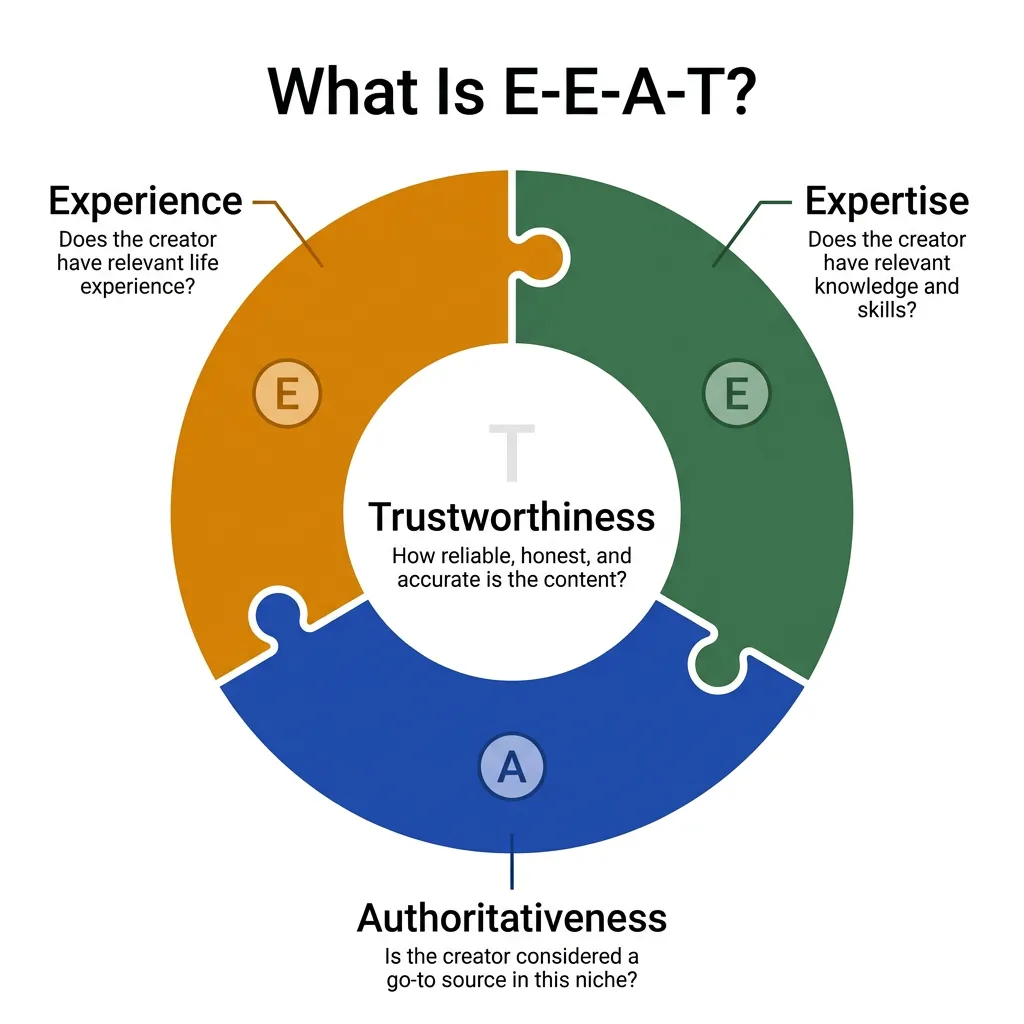
E-E-A-T stands for Experience, Expertise, Authoritativeness, and Trust. Google added the first "E," Experience, in December 2022 to reward content from people who have actually done the thing they write about.
Here is each one in plain terms, for a business that sells real products or services:
- Experience — Have you actually done this? A plumber who writes about fixing a specific boiler fault has it. A page that rewrites ten other articles does not.
- Expertise — Do you know the subject deeply? This shows in how clearly and accurately you explain it, not in a framed certificate.
- Authoritativeness — Do others treat you as a go-to source? Reviews, mentions, and links from people in your field all count.
- Trust — Can a stranger rely on you? Clear contact details, a secure site, honest pricing, and accurate content build it.
One of these is not like the others. Google's Search Quality Rater Guidelines state that "Trust is the most important member of the E-E-A-T family," because an untrustworthy page has low E-E-A-T no matter how experienced or expert it appears.
That single line tells you where to start. Not with blog posts. With trust.
When E-E-A-T Is Non-Negotiable: YMYL Businesses
For some businesses, E-E-A-T is not optional polish — it is the price of ranking at all. Google calls these YMYL topics, short for "Your Money or Your Life." They cover anything that could affect a person's health, finances, safety, or major life decisions.
If you run a clinic, a law firm, an accountancy practice, or a financial advice service, Google holds your pages to a higher standard. It wants visible credentials, accurate and current information, and clear accountability for who is giving the advice. A vague, anonymous page in these fields will struggle no matter how well written.
The fix is straightforward, if not always quick. Name the qualified person behind the advice, show their credentials, cite reputable sources, and keep the information current. In YMYL fields, trust is not a tiebreaker — it is the entry fee.
If your business sells cushions or coffee, the bar sits lower. But the direction is identical: the more a decision matters to your customer, the harder Google looks at whether it can trust you.
Why Small Businesses Have an E-E-A-T Advantage, Not a Handicap
Most owners read about E-E-A-T and panic. They have no press coverage, no famous founder, and no budget to earn links from national publications. It feels like a game rigged for big brands.
It is not. Google has spent years trying to surface content from real people and real businesses, partly because large brands so often publish thin, generic pages. A boutique studio, a single-location clinic, or a two-person agency can win here precisely because they have what big brands fake.
You have done the work. You have real clients, real projects, and real opinions formed by doing the job hundreds of times. That is Experience and Expertise in their purest form — and it is the one thing a content farm cannot manufacture.
The advantage is specificity. A national chain writes "5 tips for choosing a contractor." You can write "what we found re-roofing 40 Victorian terraces in one winter." One reads like filler. The other could only come from you.
That is the whole game for a small business: trade reach you do not have for depth no one else can match.
Start With Trust: The E-E-A-T Fixes That Matter First
Because Google calls Trust the foundation of E-E-A-T, it is where every small business should start. These are the fixes that cost almost nothing and signal reliability fastest.
Make your business easy to verify. Add a real contact page with a phone number, an email, and a physical or service-area address. A site that hides who is behind it reads as risky — to visitors and to Google.
Secure the site and clean up the basics. Run on HTTPS, fix broken pages, and make sure your business name, address, and phone number match everywhere they appear online. Inconsistent details quietly erode trust.
Put proof where people look. Display genuine reviews, name your team, and be transparent about pricing and policies. A visible, well-answered set of Google reviews does more than any "trusted by thousands" banner.
Trust is the gate. Until a page clears it, no amount of expertise or authority will lift it. Fix this layer before you write a single new blog post.
How to Show Experience and Expertise When You're Not Famous
This is where most small business content fails. It is written to "rank for a keyword" instead of to prove a person did the work. The fix is to put real experience on the page, visibly.
Start with the author. Every article should carry a byline, a short bio, and a link to a real person with real history. A page written by "admin" signals nothing. A page written by someone who has audited 120 small business sites signals expertise instantly.
Write in the first person, from real jobs. Describe the decision you made, the tool you used, and the number you saw. "We moved a client's checkout to a single page and recovered 18% of abandoned carts" beats "improving checkout can boost conversions" every time.
Use the formats that prove experience:
- Case studies — one real project: the problem, what you did, the result.
- Original photos — your work, your team, your premises, not stock images.
- Specific advice — the mistake you watch clients make, named and explained.
Google's guidance on helpful content asks one core question: does this read like it was written by someone with first-hand experience? For a small business, the honest answer should be yes — you just have to show it on the page.
Building Authority Without a PR Budget
Authority is the slowest pillar to build and the one owners worry about most. You do not need coverage in a national paper. You need to be known and referenced in your specific corner of the web.
Start local and specific. Claim and complete your Google Business Profile, get listed in reputable local and industry directories, and make sure every listing uses identical business details. These are the mentions within reach of any small business.
Earn links by being useful, not by buying them. A genuinely helpful guide, a free local resource, or a partnership with a supplier or trade body earns links that actually count. Ten relevant links from your industry beat a hundred random ones.
Go deep on one topic, not wide on many. Covering your niche thoroughly — every real question a customer asks — builds what SEOs call topical authority. For a small business, depth in one area is far more achievable than breadth across everything.
Authority compounds. Each helpful page, each real review, each industry mention adds to a picture Google builds over months. Start now and it works quietly in the background.
How to Audit Your Own E-E-A-T in an Afternoon
Here is what almost every other guide leaves out: how to check where you actually stand. You do not need a tool or a consultant. You need one honest hour with your own site.
Open your most important page and ask the four questions a Google rater would:
- Experience — Does this page show first-hand knowledge? Look for real examples, original photos, and details only a practitioner would know.
- Expertise — Is it clear who wrote this and why they are qualified? Check for a named author and a real bio.
- Authority — If a stranger searched your business name, what would they find? Look at your reviews, your Google Business Profile, and any mentions.
- Trust — Can someone verify and contact you in under ten seconds? Check the contact page, HTTPS, and whether your details match across the web.
Score each pillar from 1 to 5. Any pillar under 3 is your priority. Most small businesses find Trust and Experience are solid and Authority is weak — which tells you exactly where to spend the next month.
Repeat this on your three most valuable pages. The gap you find is your roadmap — and it is far more useful than another generic checklist.
E-E-A-T in the Age of AI Search
Something changed in the last two years, and most small business advice has not caught up. Search is no longer only ten blue links. Google's AI Overviews, ChatGPT, and Perplexity now answer questions directly, and they pull those answers from sources they judge trustworthy.
E-E-A-T is how that judgment gets made. Answer engines favour content with clear authorship, verifiable facts, and a real business behind it — the same signals E-E-A-T describes. A site that reads as anonymous and unsourced rarely gets cited.
This is sometimes called answer engine optimisation: structuring content so a machine can quote it with confidence. The foundation is the same trust layer we started with. If a human rater would not trust your page, a model trained on those standards will not either.
For a small business, the opportunity is real. Being named in an AI answer puts you in front of someone before they ever see a list of competitors. Trust is now the cost of entry — not just to rankings, but to being mentioned at all.
The E-E-A-T Mistakes That Quietly Hurt Small Sites
Most small businesses do not lose trust through one big error. They lose it through small signals that quietly tell Google — and visitors — to be cautious. These are the ones worth fixing today.
Publishing anonymous content is the most common mistake. A blog full of useful posts with no named author throws away every Experience and Expertise signal you earned by writing them. Put a real person's name and face on your content.
Faking or buying reviews is the most dangerous. Google and review platforms are good at spotting patterns, and the penalty for getting caught is far worse than a few honest three-star ratings. Real reviews, including the occasional critical one, read as more trustworthy than a wall of fives.
Then there is thin, mass-produced content. Spinning up twenty AI-written posts to "cover more keywords" is the fastest way to look disposable when a core update lands. One page that proves real experience outranks ten that prove nothing.
The pattern is simple. Anything that hides who you are, or fakes who you are, works against E-E-A-T. Everything that reveals the real business behind the site works for it.
How Long E-E-A-T Takes (and What It's Worth)
The honest answer: trust fixes work in days, authority takes months. That split is the most useful thing to understand before you start.
The trust layer — contact details, HTTPS, reviews, clear authorship — can be sorted in a week or two. These are the changes that protect you during core updates, so do them first. They are cheap, fast, and they stop the bleeding.
Authority and a track record of helpful content build over six to twelve months. There is no shortcut, and any service promising instant authority is selling the snake oil the skeptics warned about. The payoff is durability: a site built on real E-E-A-T holds steady when algorithms shift.
For a small business weighing the effort, frame it this way. You are not chasing a ranking trick — you are building the same reputation offline that earns referrals, made legible to Google and the AI models now reading your site.
Where to Take This Next
E-E-A-T rewards businesses that already do good work and simply make it visible. If you have read this far, you likely have the experience and the trust. What is missing is a site built to show them.
That is the part we handle. At Vediwood, SEO and trust signals are built into a site from the first wireframe, not bolted on later. If you want a website engineered to earn trust from both Google and your customers, see how we approach a web project.
No pitch, no jargon — just a site that finally reflects how good your business actually is.
Follow Us
Most founders read us once and change something that week.
Every issue covers one thing that makes your website work harder — better conversion, stronger SEO, or smarter design. No fluff, no agency speak. Just the decision you need to make this week.
Our Team

Sadiki Said
Full Stack Developer

Nezha Essyed
Content Strategist